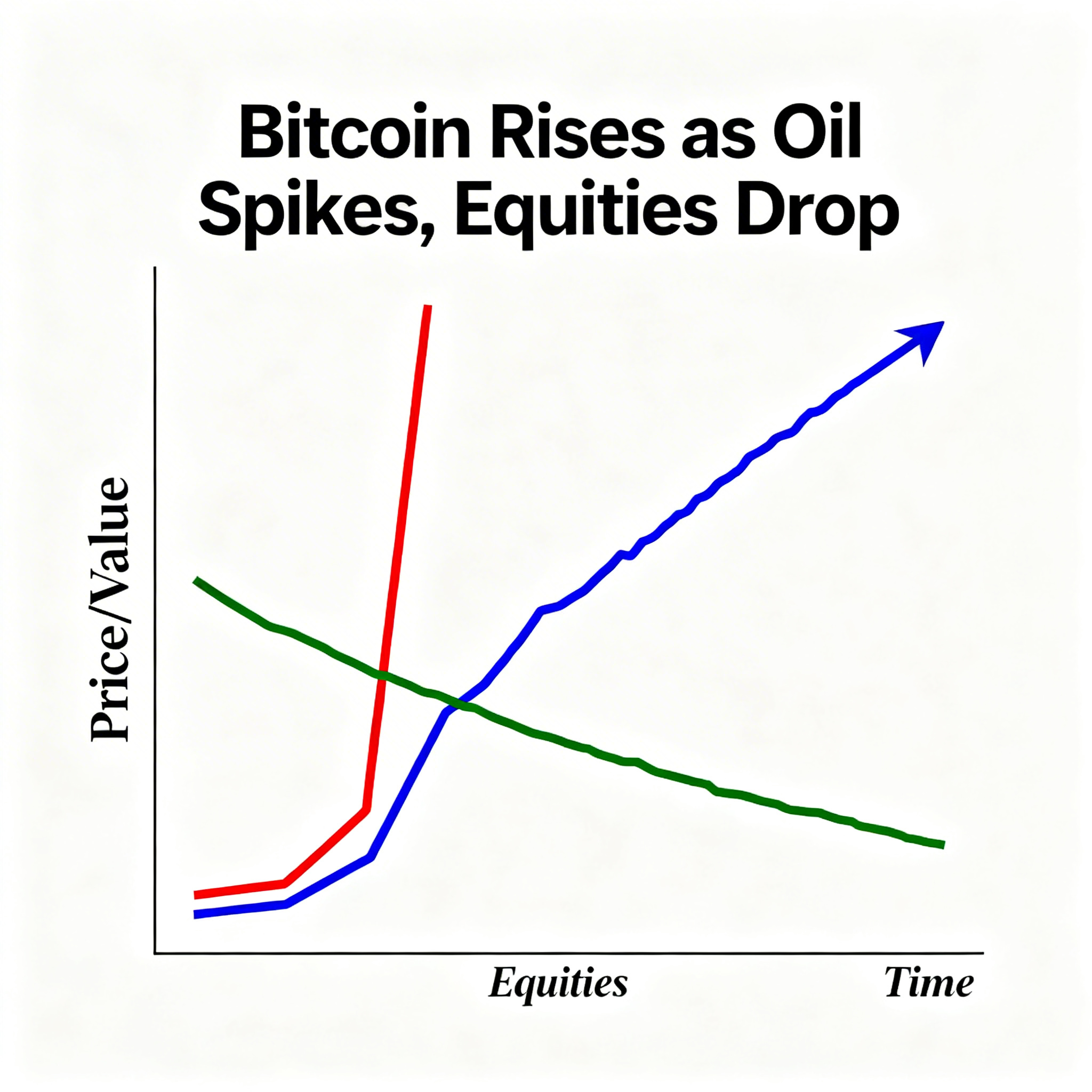
Bitcoin advanced during European trading hours, even as traditional markets weakened, underscoring the cryptocurrency’s relative strength amid rising oil prices and geopolitical uncertainty.
The largest digital asset gained roughly 2.8% since midnight UTC, recovering after global markets initially dropped when futures trading opened earlier in the session.
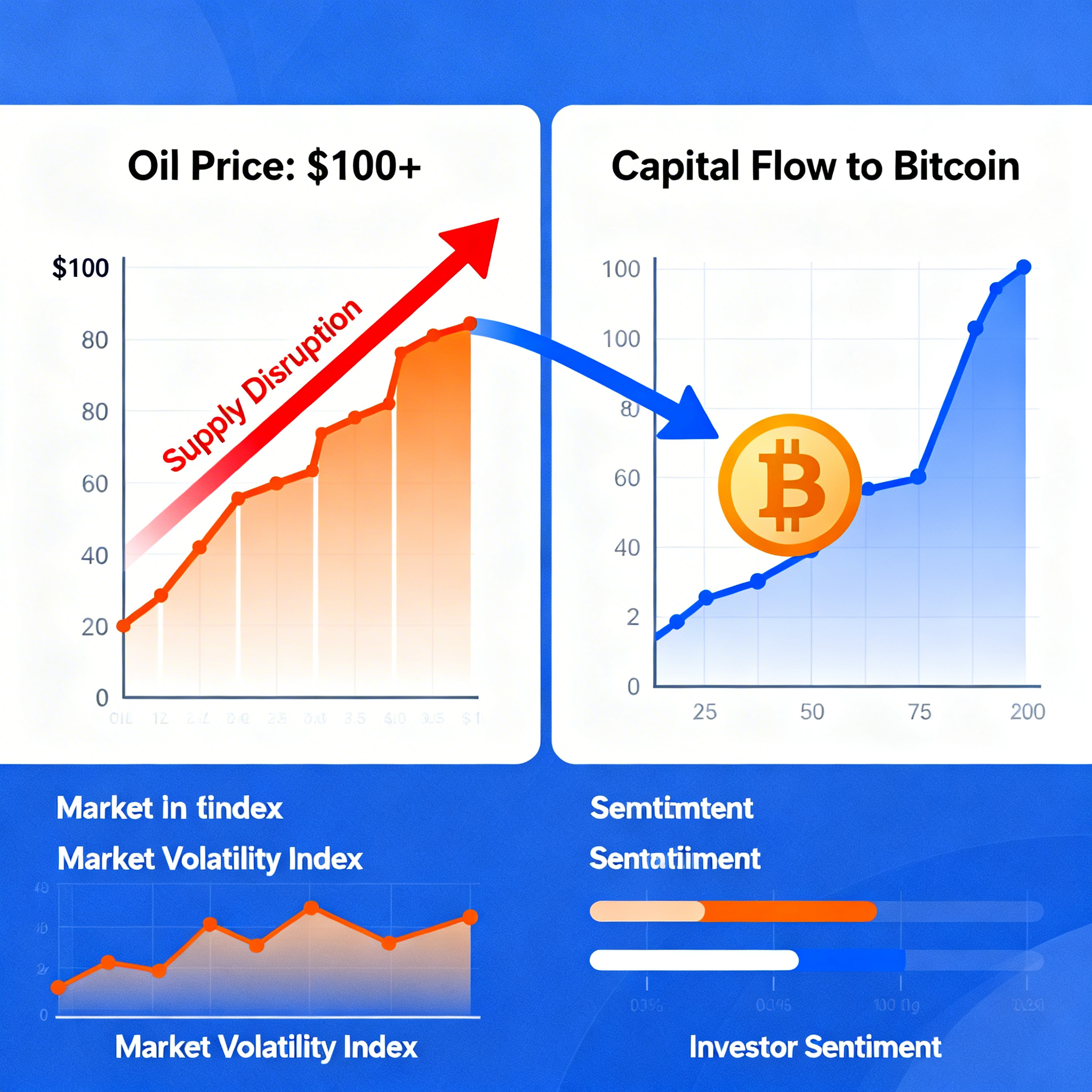
Equity markets, however, continued to struggle. Futures tied to the Nasdaq-100 and the S&P 500 both fell more than 1.5% since midnight as oil prices surged to as high as $115 per barrel, the highest level since June 2022. Precious metals also declined, with gold down 1.6% and silver losing 1.1%, weakening their typical safe-haven appeal as investors shifted toward the U.S. dollar.
Despite turbulence in broader markets, sentiment around bitcoin appears to be improving. The asset has remained resilient even as tensions linked to Iran and disruptions to shipping through the Strait of Hormuz threaten global energy supplies.
Crypto trading firm QCP Capital noted that bitcoin’s practical role in the financial system may be gaining relevance.
“While BTC has not fully cemented its status as digital gold, its utility as a digital escape route is becoming increasingly meaningful—particularly in Gulf nations experiencing currency volatility and political uncertainty,” the firm said in a Monday note.
Derivatives positioning
Market volatility triggered significant liquidations in crypto derivatives. Exchanges have closed nearly $400 million worth of crypto futures positions in the past 24 hours. Traders betting against oil were hit especially hard as crude prices climbed toward $115 per barrel.
Open interest in bitcoin futures remains near weekly lows at roughly 650,000 BTC, indicating that derivatives traders have yet to fully participate in Monday’s price rally. Meanwhile, open interest in Ether futures increased to around 13 million tokens.
Open interest in XRP rose to 1.72 billion tokens, the highest level since Feb. 24. A modest rise in Solana futures open interest also suggests fresh capital entering those markets.
In contrast, open interest in tokens such as PAX Gold, Avalanche, and Litecoin has declined over the past day, indicating that some investors are reducing exposure during the price rebound.
Volatility expectations for bitcoin and ether remain steady. Their 30-day implied volatility indexes show little change, suggesting relative calm in crypto derivatives markets despite sharp moves in oil and Asian equities.
On the derivatives exchange Deribit, put options for bitcoin and ether continue to trade at a premium over calls, signaling ongoing demand for downside protection. However, the size of the premium has remained largely unchanged from last week, indicating that the spike in oil prices has not triggered a major increase in hedging demand.
Bitcoin’s implied volatility curve also remains in backwardation, meaning traders expect greater volatility in the near term than in the longer term—a reflection of the uncertainty surrounding the evolving geopolitical situation.
Token market activity
Altcoins broadly gained overnight. Privacy-focused tokens such as Dash, Monero, and Zcash posted gains ranging from about 3.8% to 5.2%.
Decentralized finance tokens also performed strongly. Ether.fi and Morpho both outperformed bitcoin and ether during the same timeframe.
Momentum across the broader altcoin market appears to be improving. The “Altcoin Season” indicator tracked by CoinMarketCap currently stands at 36 out of 100, a significant rebound from February’s low of 22.
Among sector benchmarks, the CoinDesk Computing Select Index—which includes tokens such as Chainlink and Bittensor—was the top performer over the past 24 hours, rising 2.7%. It was followed by the CoinDesk Smart Contract Platform Select Index, which gained 0.92% since Sunday morning.
On the downside, the institutional-focused token Canton Network Token fell 3.4% in the past 24 hours. Meanwhile, Worldcoin—a project associated with Sam Altman—declined about 2% over the same period.