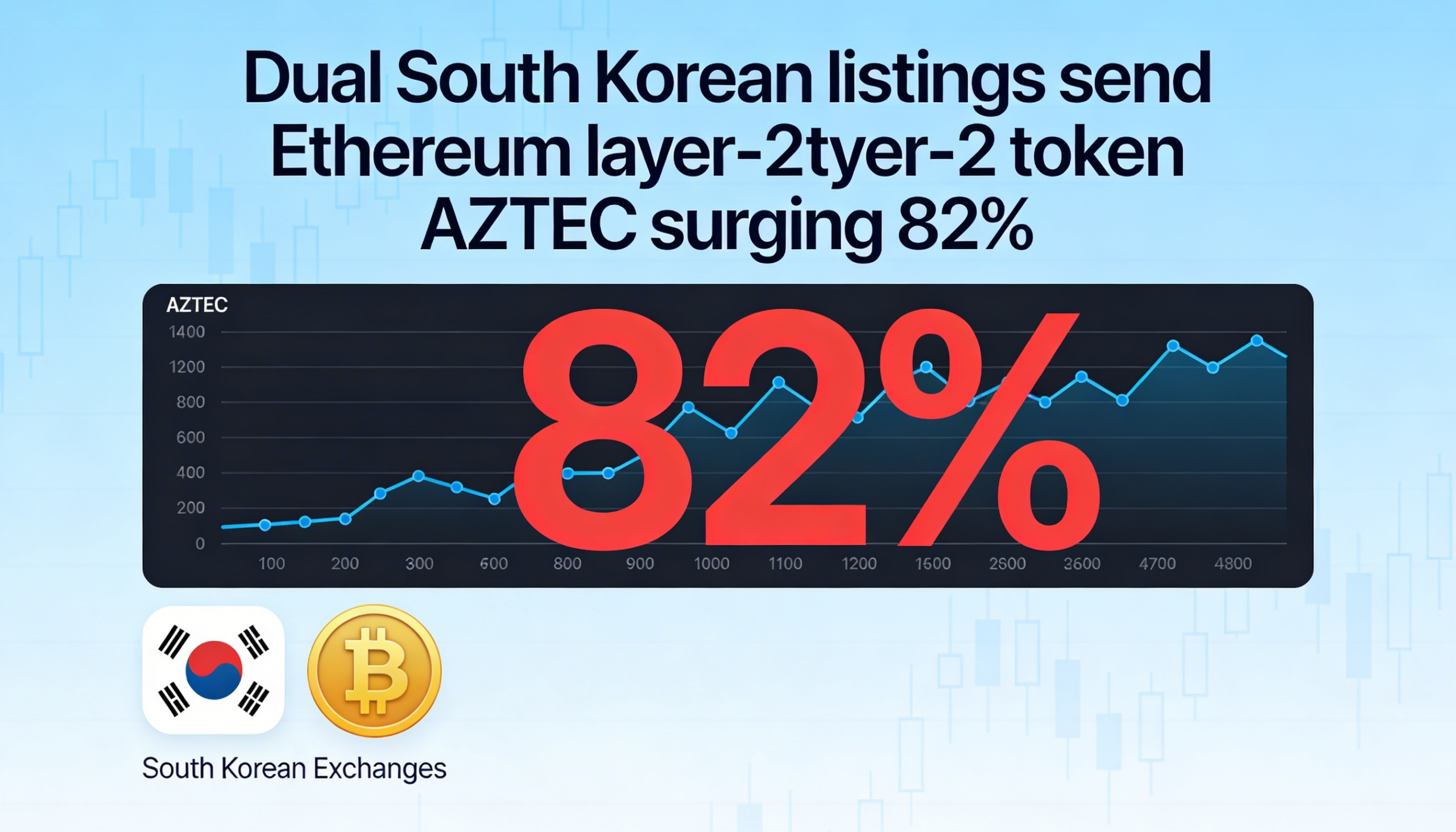
Aztec (AZTEC) jumped sharply after South Korean exchanges Upbit and Bithumb each introduced KRW trading pairs for the privacy-focused Ethereum layer-2 token, unleashing a burst of local buying in what had been a relatively thin market.
The token rallied roughly 82% over 24 hours to trade near $0.035, driven largely by won-denominated inflows following the dual listings.
Listings on major Korean platforms continue to act as strong catalysts, particularly for smaller-cap tokens. The addition of a KRW pair shifts trading from crypto-only access to direct participation by South Korea’s sizable retail investor base.
South Korea consistently ranks among the most active crypto markets globally relative to its population. Upbit alone frequently rivals or surpasses Coinbase in daily spot trading volume during busy sessions.
A direct KRW market removes the need to route trades through stablecoins like USDT, integrating the asset into Korea’s highly active spot trading environment and placing it prominently in front of domestic traders. For emerging tokens such as AZTEC, that added visibility can significantly alter liquidity and price momentum.
New listings on Upbit and Bithumb are often viewed as short-term momentum events. Traders tend to move quickly, positioning ahead of deeper liquidity and before any initial price premium fades. Similar patterns have played out in the past, with tokens such as VIRTUAL posting double-digit gains on Korean listing announcements alone.
In shallow order books, concentrated buying can create steep, vertical price moves — precisely what AZTEC experienced. As prices spike on Korean venues, arbitrage traders typically buy on global exchanges and sell into the stronger local bid, helping lift prices internationally. During these episodes, the so-called “kimchi premium” — the price gap between Korean and offshore markets — often widens before narrowing as arbitrage flows close the spread.
Beyond the listing-driven rally, Aztec positions itself as a privacy-oriented Ethereum layer 2 that uses zero-knowledge proofs to enable encrypted transactions on a public blockchain, giving the project a broader narrative beyond exchange momentum.
By the Asian evening session, the premium had begun to narrow as arbitrage activity increased and the initial surge showed signs of losing steam.