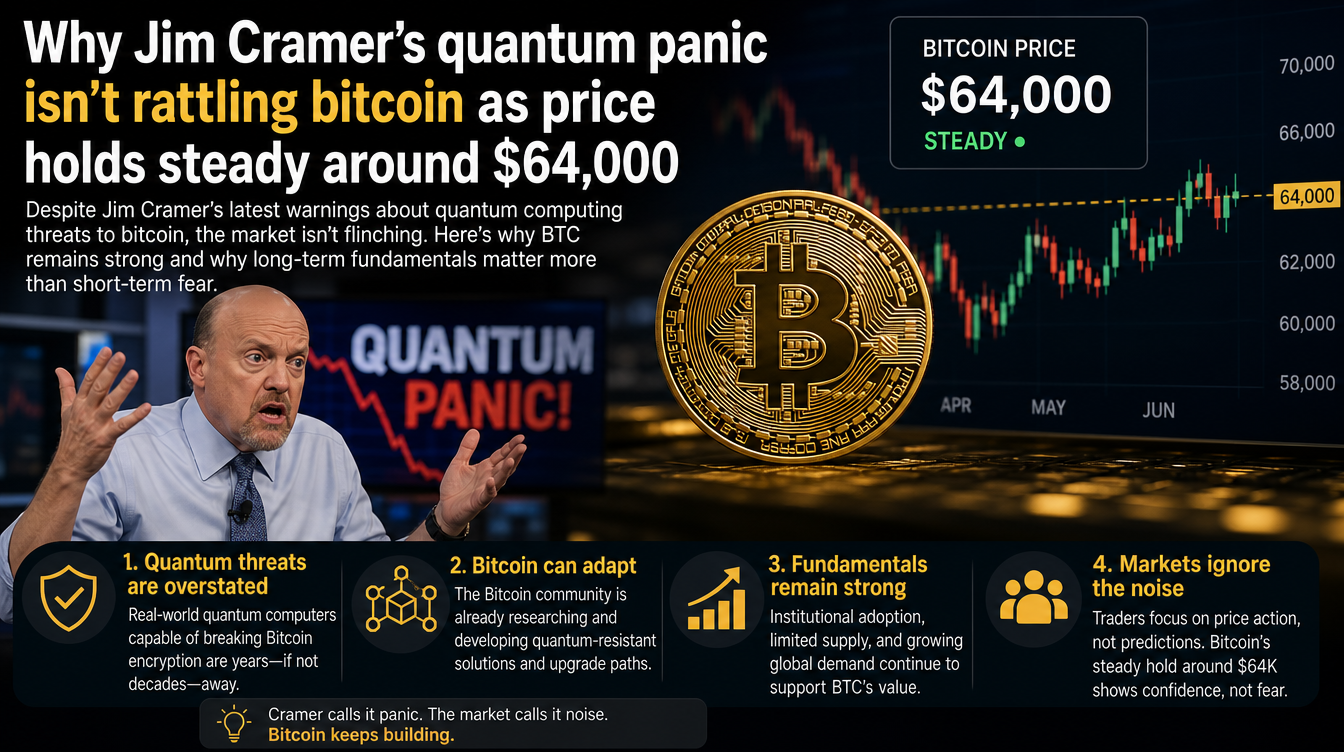
Jim Cramer’s decision to sell his bitcoin holdings due to concerns about quantum computing has received an unexpectedly positive response from parts of the crypto community, largely because of his history of market predictions that often turn out to be controversial.
The “Mad Money” host said he plans to exit his entire bitcoin position after warning that rapid advances in quantum computing could pose a threat to cryptocurrencies over the next three to four years.
His comments came after a July 31 interview with IBM Chairman and CEO Arvind Krishna, who told Cramer that quantum computers could eventually challenge current encryption methods within that timeframe. Krishna urged investors to remain highly cautious about the potential risks.
The actual size of Cramer’s bitcoin holdings remains unknown. No wallet addresses connected to him have been identified or monitored by blockchain analytics companies, making it impossible to confirm whether he currently owns BTC or has started selling his coins.
Despite Cramer’s planned exit, some crypto investors viewed the move as a positive signal.
“Jim Cramer did it again. Bitcoin just received the strongest buy signal of 2026,” a self-described bitcoin maximalist posted on X.
Others shared similar reactions, while bitcoin continued to show strength near $64,000 despite recent challenges, including the Coldcard wallet exploit and rising bond yields.
The “Inverse Cramer” Reputation
The crypto community’s reaction is closely linked to Cramer’s reputation as a potential contrarian indicator. The “inverse Cramer” strategy, which involves taking the opposite side of his market calls, became such a popular joke that it led to the creation of the Inverse Cramer Tracker ETF (SJIM) in 2023. The fund attempted to profit by shorting assets he recommended but closed in early 2024 after failing to attract significant investor interest.
Cramer’s reputation stems from several high-profile market reversals and inaccurate predictions.
In December 2017, as bitcoin approached its first major rally toward $20,000, Cramer dismissed the cryptocurrency as “monopoly money” and said buying it was speculation rather than investing. However, by September 2020, he reportedly purchased bitcoin near $10,000 following a podcast discussion with investor Anthony Pompliano and later increased his exposure.
His position shifted again in June 2021 when he sold most of his bitcoin holdings, citing China’s crackdown on cryptocurrency mining. Bitcoin later reached a record high near $70,000 in November 2021.
In January 2024, Cramer warned that bitcoin could face a severe sell-off after the launch of spot bitcoin ETFs in the U.S. Although BTC briefly declined toward $40,000, the drop was limited, and prices recovered to around $70,000 by March.
Cramer changed his stance again in January 2025, describing bitcoin as a strong portfolio asset and encouraging investors to hold BTC directly rather than gaining exposure through bitcoin treasury company Strategy.
Last month, he shifted bearish once again, calling bitcoin and gold “bad money” and saying investors were moving funds into high-growth assets such as SpaceX, Apple, and Nvidia. His latest position in August 2026 is a plan to completely leave bitcoin.
Cramer’s most criticized recent prediction, however, came from traditional finance. On Feb. 8, 2023, he described Silicon Valley Bank as undervalued and said concerns about the bank were exaggerated. Just weeks later, SVB collapsed in what was then the second-largest bank failure in U.S. history.
For now, bitcoin’s market performance suggests investors are not taking Cramer’s quantum computing warning as an immediate concern. BTC has remained stable around $64,000 despite the Coldcard security incident and Strategy’s disclosure of recent bitcoin sales.