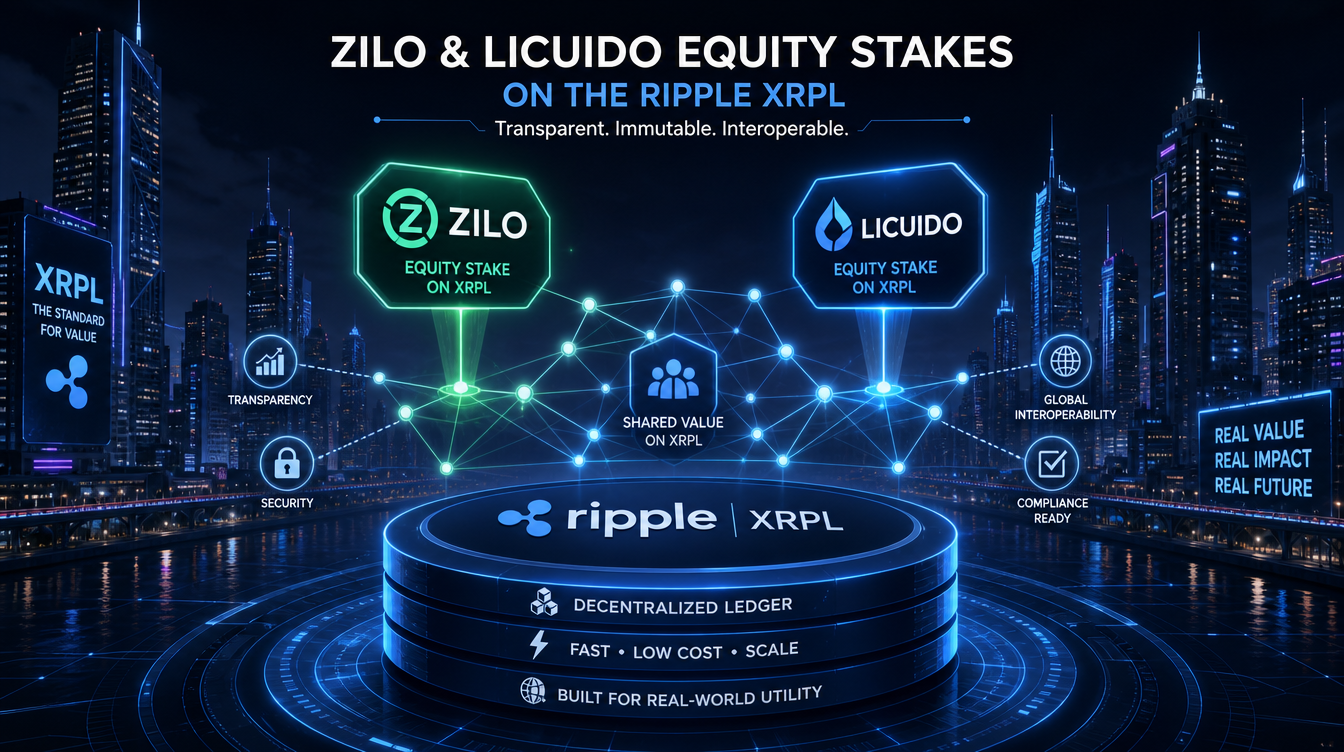
Ripple has converted its UK partnerships with Zilo and Licuido into equity stakes, reinforcing its XRP Ledger (XRPL) capital markets stack with regulated transfer agency, compliant issuance, and collateral mobility infrastructure.
Announced on August 3, 2026, the investments formalize existing relationships and bring critical institutional capabilities onto XRPL, including regulated ownership records, digital asset issuance, and the ability to move tokenized assets as collateral across markets.
The move targets a key limitation in institutional tokenization. Tokenized fund shares only gain practical utility when they can be financed, pledged, and settled with legal certainty. Achieving this requires regulated registries, compliant issuance rails, and atomic delivery-versus-payment settlement — functions delivered by Zilo and Licuido.
The announcement coincides with XRP trading at $1.07, up roughly 0.5% over 24 hours and 1.7% over the past week, with daily volume around $965 million.
XRPL Infrastructure: Roles of Zilo and Licuido
Zilo provides the transfer agency and fund administration layer, maintaining regulated records of ownership for tokenized shares — a foundation for extending credit against fund holdings.
Licuido, regulated by the UK Financial Conduct Authority (FCA), handles issuance, distribution, execution, and collateral mobility, enabling tokenized assets to circulate through on-chain markets rather than remain idle.
RLUSD, Ripple’s dollar-pegged stablecoin, functions as the settlement layer, allowing delivery-versus-payment transactions where asset and cash transfers settle simultaneously on XRPL, typically within seconds.
Together, Zilo’s ownership registry, Licuido’s issuance and liquidity rails, and RLUSD’s settlement mechanism aim to complete the lifecycle of tokenized assets on a single ledger.
From Pilot to Production
Ripple’s investments build on infrastructure already in use. Licuido previously powered the tokenization of the Aviva Investors USD Liquidity Fund on XRPL, which launched on July 29, 2026, becoming the first tokenized fund approved by the Central Bank of Ireland on a public blockchain.
This forms part of a broader institutional strategy. In February 2026, Ripple partnered with Aviva Investors — managing $345 billion in assets — to tokenize fund structures on XRPL.
Separately, a memorandum of understanding with DBS and Franklin Templeton outlined a pathway for the sgBENJI tokenized money market fund to serve as repo collateral on DBS Digital Exchange alongside RLUSD, reinforcing the same collateral mobility framework these new investments aim to scale.
The Next Test: Liquidity at Scale
Ripple executive Nigel Khakoo noted that tokenization is only the starting point, with real value emerging from trading, settlement, lending, and margining activity.
While XRPL has demonstrated issuance capabilities through projects with Aviva and Franklin Templeton, the focus is now shifting to whether these assets can achieve meaningful secondary liquidity and function as institutional-grade collateral. The next 12 to 24 months will be critical in determining whether these markets gain traction or remain limited in activity.
Ripple is also part of a UK government-backed task force involving 54 firms — including Circle, BlackRock, and J.P. Morgan — working toward live tokenized repo use cases within the year.
Meanwhile, XRPL is preparing to roll out its next major upgrade, xrpld 3.3.0, aimed at enhancing tokenization functionality and institutional finance capabilities.