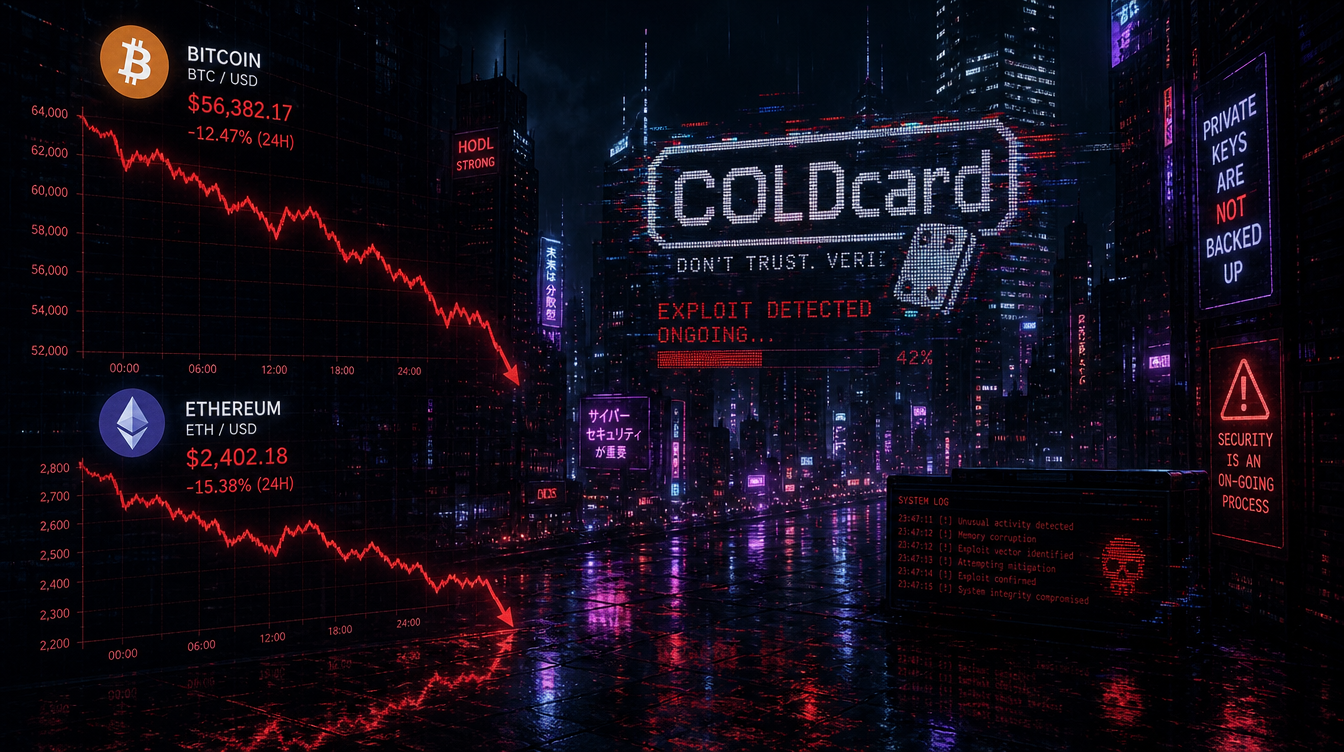
The decline in crypto prices has remained relatively contained despite the scale of the Coldcard wallet breach, the millions in losses involved, and the growing concerns surrounding the security of hardware-based self-custody.
Bitcoin (BTC) and ether (ETH) continue to face selling pressure as the Coldcard hardware wallet exploit moves into its fifth day, increasing concerns about the risks of holding digital assets directly rather than through third-party platforms.
The incident has shaken confidence across crypto communities, with many smaller investors reporting losses of long-held bitcoin holdings and reconsidering their reliance on self-custody solutions.
Marex analysts said the attack has created an additional challenge for market sentiment by pushing some investors to transfer their coins back to exchanges, reversing the industry’s long-running shift toward self-custody. They noted that falling prices alone cannot address concerns when the security of cold storage itself is being questioned.
Given the estimated $114 million worth of bitcoin stolen, the market response has been relatively limited. Bitcoin recently declined 1.5% over 24 hours to around $62,595, a price level it has revisited multiple times in recent weeks. Ether fell nearly 2% to $1,842, while the CoinDesk DeFi Select Index dropped 2.5%.
Bitcoin’s 200-week simple moving average, currently positioned above $63,000, has returned to traders’ attention after Strategy, led by Michael Saylor, said it is tracking the long-term indicator. The company also suggested it could resume bitcoin purchases after pausing acquisitions for five weeks, its longest break to date, with funding potentially coming from preferred stock issued at a 12% yield.
Geopolitical uncertainty continues to add complexity to markets. President Donald Trump said discussions with Iran were set to begin, but Iranian officials quickly rejected the claim. Foreign Ministry spokesperson Esmaeil Baghaei said Iran had no plans to host a U.S. delegation or send its own representatives for negotiations.
Derivatives Market Overview
Short positions gain control:
Crypto futures taker data has turned more bearish compared with the previous week, with short positions representing more than 52% of trading volume. Takers refer to market participants who immediately execute trades against available orders on an exchange’s order book.
Bitcoin futures activity increases:
Bitcoin futures open interest climbed to a one-month high of 772,000 BTC, showing renewed market participation. Positioning remains slightly positive, with annualized funding rates around 4%. However, negative 24-hour cumulative volume delta suggests sellers are actively using market orders to push prices lower.
Altcoin futures show mixed trends:
ADA, ETH, and BCH saw increases in open interest, while SOL continued to experience declining futures positions. TRX, DOGE, CC, and GRAM recorded negative funding rates, indicating stronger demand for bearish short trades. However, funding levels remain moderate, suggesting short positions have not become excessively crowded.
Options market remains calm:
Despite the Coldcard exploit and higher Treasury yields, crypto options markets have not shown signs of significant stress. The BVIV 30-day implied volatility index has stayed near 37% for four straight days, indicating relatively stable expectations for future price movements.
Bullish options remain popular:
On Deribit, traders are showing strong interest in call options with strike prices at $68,000 and $70,000, signaling that some market participants still expect upside potential.
Token Developments
NEAR Protocol’s Intents system has processed more than $24 billion in lifetime transaction volume, according to the project’s latest monthly development report. The system enables users to specify desired outcomes, such as swapping tokens across different blockchains, while the network automatically determines the best execution route.
The increase followed the rollout of protocol version 2.13, which introduced improvements including quantum-resistant transaction signing and dynamic resharding. Quantum-safe signing strengthens network security against potential future quantum computing threats, while dynamic resharding allows the blockchain to automatically expand processing capacity as activity increases.
NEAR is also increasing its focus on artificial intelligence through AI compute staking, allowing token holders to lock NEAR to support computing resources used by AI applications and earn rewards linked to demand for AI infrastructure.
NEAR was recently trading at approximately $1.72, according to CoinDesk data.