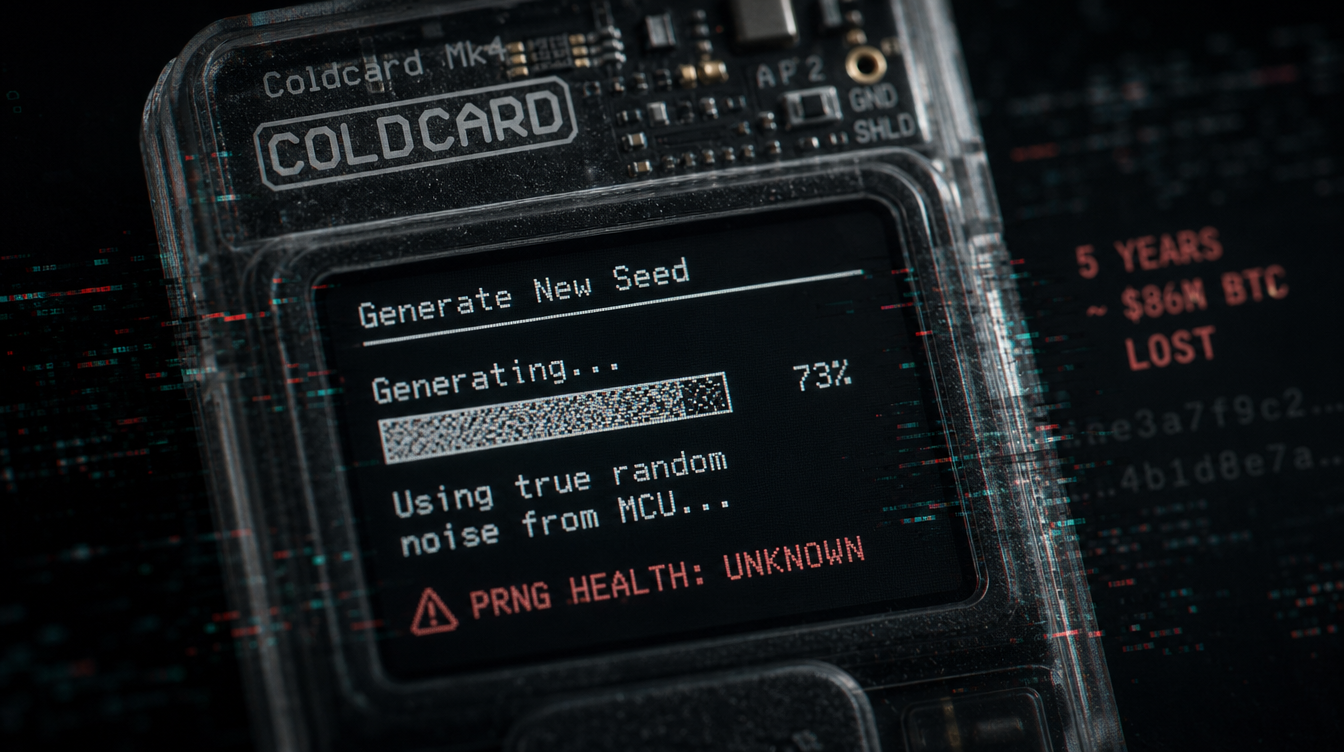
A configuration mistake in Coldcard firmware quietly weakened wallet seed generation for nearly five years, resulting in the theft of 1,367 BTC from 4,585 addresses.
A recently identified pseudo-random number generator (PRNG) vulnerability in Coldcard hardware wallet firmware, dating back to March 2021, has led to confirmed losses of 1,367 BTC, worth approximately $86 million, according to on-chain analysis released by Galaxy Research on Aug. 2, 2026.
The incident is now considered the largest confirmed hardware wallet exploit in Bitcoin history by the amount of funds lost. The attack required no phishing attempts, no physical access to affected devices, and no mistakes from users. Instead, it exposed a fundamental weakness in the assumptions behind self-custody security.
The breach demonstrates that the reliability of any self-custody system depends on the strength of the random seed generation process. A single coding configuration error was enough to undermine wallet security for years while remaining undetected and producing no visible alerts.
The exploit occurred as Bitcoin traded 1.4% lower on the day at around $62,250 after a turbulent week that saw the asset retreat from above $65,000. Bitcoin’s daily trading volume was approximately $16.9 billion, down from more than $20 billion a day earlier.
How the Coldcard Vulnerability Reduced Wallet Security
The underlying issue was discovered by Block’s engineering team in Coldcard’s libngu library. Coinkite had set a board configuration value to zero to disable MicroPython’s built-in random number generator and ensure the device used its hardware true random number generator (TRNG).
However, the libngu validation process only checked whether the configuration macro existed, not whether its value was correct. Because of this, the zero setting passed the check.
This caused MicroPython to remove the STM32 hardware RNG function during compilation and instead rely on Yasmarang, a software-based PRNG with only about 40 bits of effective entropy. That was far below the 128 bits of randomness expected for a BIP-39 recovery seed.
Later Coldcard models, including the Mk4, Mk5, and Q, improved the situation by increasing effective entropy to an estimated 72 bits. However, that level still remained below the recommended standard. The difference between 40-bit entropy and 128-bit entropy significantly changes the difficulty of recovering vulnerable seeds through brute-force methods.
Coinkite released a security notice on July 30, 2026, shortly before attackers drained approximately 594 BTC from around 500 wallet addresses. Further attack waves followed, increasing the total stolen amount to 1,367.05 BTC across 4,585 addresses by Aug. 2.
Most of the stolen Bitcoin remains untouched on-chain, indicating that the attacker has not yet moved or liquidated the funds.
Coldcard Exploit Highlights Broader Crypto Security Risks
The Coldcard incident is part of a wider history of cryptocurrency attacks caused by weak randomness during key generation.
In 2013, a vulnerability in Android’s SecureRandom implementation caused repeated ECDSA nonces, exposing private keys from multiple Bitcoin wallets. In 2022, the Profanity vanity address generator flaw contributed to the Wintermute hack, where attackers exploited weak 32-bit entropy and stole about $160 million.
Another example came in 2023 with the Milk Sad vulnerability, which affected Libbitcoin Explorer’s bx seed tool. The software used a Mersenne Twister generator seeded with system time, reducing the expected 256-bit entropy to roughly 32 bits and exposing more than 120,000 wallets.
Although these incidents involved different platforms and technologies, they shared the same root problem: relying on a randomness source that was assumed to be secure but was not.
Ari Redbord, global head of policy at TRM Labs, said the Coldcard incident shows that self-custody does not eliminate security risks but instead changes where those risks appear. TRM Labs data from the first half of 2026 showed that infrastructure and key-related compromises represented 15% of reported incidents but accounted for 76% of total financial losses across 207 hacks.
Galaxy Research said it has identified around 600 wallet addresses believed to be controlled by the attacker and has shared the findings with federal investigators, compliance providers, and cybersecurity organizations.
The firm also noted that its Coldcard attribution is based on blockchain analysis and behavioral indicators rather than direct computational reconstruction of seed phrases for every affected address.