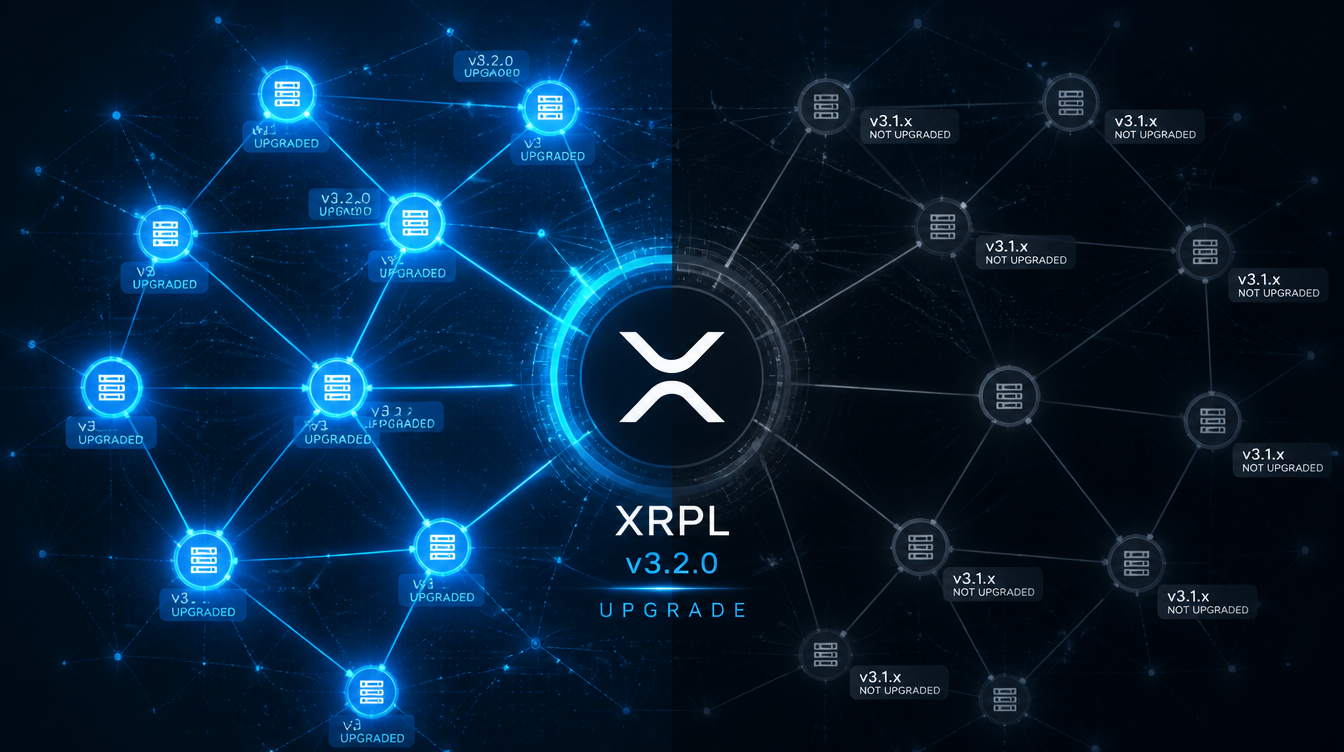
Roughly 89% of UNL validators are now running xrpld v3.2.0, but the fixCleanup3_2_0 amendment has only secured 48.57% support—well below the 80% required for activation on the XRP Ledger.
Almost a month after the rollout of xrpld v3.2.0—the rebranded successor to Ripple’s core server—XRPScan data shows that just 357 of 828 nodes (43%) have upgraded. In contrast, 426 nodes (51%) remain on the older v3.1.3 version.
This gap reflects more than a slow upgrade cycle. It underscores XRPL’s two-layer governance structure, where validator adoption consistently outpaces the broader node network. In practice, validator consensus—not total node participation—determines when the network is operationally ready.
Meanwhile, XRP has declined 3.5% over the past 24 hours, slipping below $1.10 and currently trading at $1.09, with daily volume at $1.54 billion. The $1.10 level has once again turned into resistance, and unless XRP reclaims and closes above it on the weekly chart, upside momentum is likely to remain capped.
From an adoption standpoint, the key metric is validator participation. With 31 of 35 UNL validators (89%) already on v3.2.0, the network effectively treats the update as standard, since XRPL requires 80% UNL consensus for recognition. Around 61% of Ripple-operated validators have also upgraded.
For non-UNL nodes, upgrading is still optional—for now. However, once related amendments are activated, lagging nodes risk losing connectivity, as seen during the v3.1.3 / Cleanup31_ cycle in May 2026.
The v3.2.0 release formally rebrands the core server from “rippled” to “xrpld” under XLS-0095 and delivers 30–40% lower memory usage, reducing infrastructure costs. It also strengthens security, improves developer tooling, and enhances overall network efficiency.
Attention is now shifting to the fixCleanup3_2_0 amendment, which has gathered only 17 of 35 validator votes so far. Beyond reaching 80%, support must remain above that threshold for two consecutive weeks to activate—any drop resets the process.
If approved, the amendment will implement fixes across key XRPL components, including single-asset vaults, the native lending protocol, multi-purpose tokens, permissioned domains, and the permissioned DEX. These systems were introduced during XRPL’s 2026 upgrade cycle, making fixCleanup3_2_0 a refinement update rather than a new feature release.
At this stage, the critical question is no longer whether xrpld v3.2.0 has enough validator backing—it does. The focus now is whether fixCleanup3_2_0 can gain the momentum needed to cross the 80% threshold, and whether the remaining nodes will upgrade before activation raises the risk of network incompatibility.
For DeFi participants and infrastructure operators, validator voting trends will be the most important signal, as the amendment directly impacts core systems like lending, vaults, token standards, and permissioned trading rails. Nodes that delay upgrading are facing a narrowing window before pressure to comply intensifies.