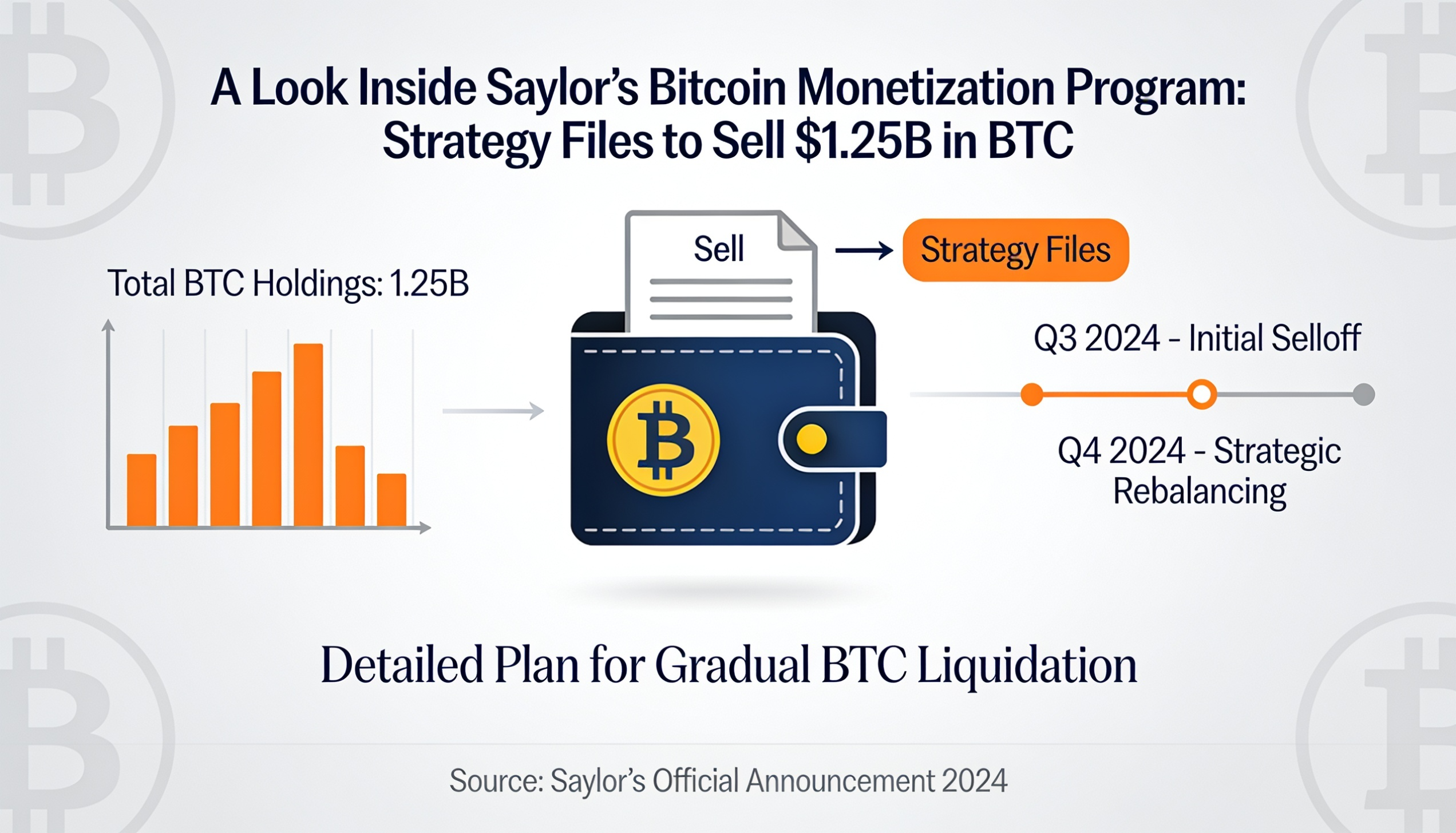
Bitcoin News: Michael Saylor’s Strategy (Nasdaq: MSTR) revealed in a June 29 filing that it may sell up to $1.25 billion worth of Bitcoin, positioning the move as part of a “Bitcoin Monetization Program” intended to enhance liquidity, fund preferred dividend commitments, and meet debt-related obligations.
The announcement signals a notable departure from Saylor’s long-standing strategy of relentless Bitcoin accumulation, a narrative he has consistently championed to both institutional and retail investors.
The shift was triggered on June 27, when Strategy’s mNAV — measuring enterprise value relative to its Bitcoin holdings — slipped below 1 for the first time. This threshold is critical, as the company’s capital strategy depended on maintaining a premium to its Bitcoin net asset value. That premium allowed Strategy to issue equity and preferred shares to acquire more BTC at advantageous terms. With mNAV now at 0.99, that model has effectively stalled.
Strategy currently holds about $2.55 billion in cash reserves and stated that any Bitcoin sales would occur “from time to time,” depending on market conditions and funding requirements, leaving the execution flexible.
At the same time, the company approved two share repurchase programs worth up to $1 billion each—one targeting Class A shares and another covering its Digital Credit Securities, including preferred series STRK, STRF, and STRD.
Financial pressure is most visible in the preferred equity layer. STRK carries an 8% annual dividend on roughly $584 million raised, while STRF offers a 10% yield that can rise to 18% if payments are deferred, based on $711 million raised. The newest series, STRD, brought in about $979.7 million at a 10% non-cumulative rate.
Altogether, these preferred instruments generate more than $700 million in annual dividend obligations. When Bitcoin traded near its late-2025 peak of around $125,000 and mNAV remained above 1, covering these costs through new equity issuance was straightforward. With BTC now near $60,000 and mNAV below 1, that approach has become significantly more difficult.
Strategy has already begun tapping its Bitcoin reserves. On June 1, the firm sold 32 BTC for approximately $2.5 million to fund preferred payouts. The latest filing, however, expands the potential scale of such sales considerably.
Recent market conditions have added further strain. Bitcoin dropped to around $58,000 last week amid roughly $3 billion in outflows, while MSTR shares also declined sharply, compressing the company’s NAV buffer. Although BTC has since recovered to about $60,175, it remains well below levels that previously supported Strategy’s capital model. Options positioning around $60,000 has also contributed to continued volatility.
Bitcoin critic Peter Schiff commented on June 29 that Strategy has effectively become “a Bitcoin seller,” underscoring the contrast with Saylor’s earlier stance that BTC should never be sold. Schiff has previously argued that Strategy’s aggressive buying helped support Bitcoin prices, a dynamic that could reverse if the firm shifts toward selling. While his remarks are critical, they highlight a broader structural concern.
Strategy has rejected claims of a strategic reversal, maintaining that Bitcoin remains its primary treasury reserve asset and emphasizing that its actions are focused on liquidity management rather than a change in long-term conviction.
The company’s board has also introduced a policy requiring sufficient reserves to cover at least 12 months of preferred dividends and interest payments. This marks a shift toward more conservative balance-sheet management and reflects reduced reliance on continuous market access.
MSTR shares were trading at $82.31 at the time of writing, down 3.5% on the day and significantly below levels seen when Bitcoin approached $125,000. The decline underscores a key point: MSTR has functioned not just as a Bitcoin proxy, but as a leveraged bet on mNAV remaining above 1—an assumption that no longer holds.
Bitcoin News: MSTR Outlook — Key Levels in Focus
Currently trading near $92, MSTR is hovering just above a psychological support level around $90. A decisive break below that level could accelerate selling pressure, particularly from investors who previously viewed the stock as a premium Bitcoin vehicle. With that premium now gone, the equity lacks both direct BTC exposure and strong operating cash flow support.
The newly approved $1 billion buyback programs offer a potential stabilizing tool for both common and preferred shares. If deployed aggressively, they could help establish a near-term price floor.
However, buyback authorization does not guarantee execution. The company’s priority remains meeting preferred dividend obligations, which limits flexibility in returning capital to common shareholders.
In the near term, MSTR is likely to trade within a range of $80 to $89, with direction closely tied to Bitcoin’s price action. A move above $63,000 could push mNAV back above 1 and reopen the equity issuance pathway. Conversely, a drop toward $55,000 may force larger Bitcoin sales beyond the currently authorized $1.25 billion and could lead to further repricing of preferred securities.
Meanwhile, El Salvador continues to accumulate Bitcoin despite external pressures, highlighting that not all institutional holders face the same constraints as Strategy.
The next key signal will be whether Strategy executes a meaningful Bitcoin sale in the coming weeks and how markets, particularly the preferred securities segment, respond.