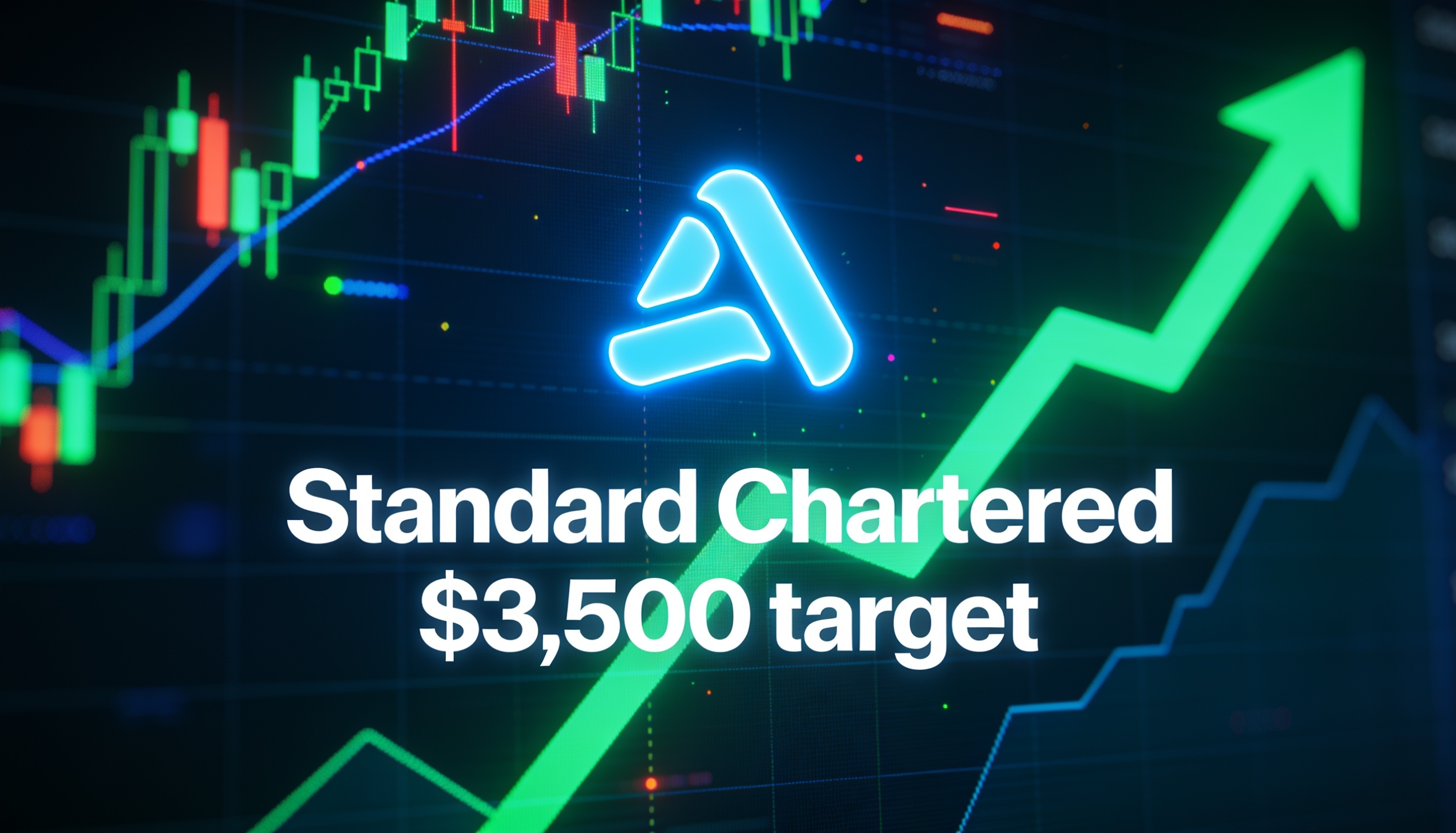
Standard Chartered Projects $3,500 AAVE Price by 2030
Standard Chartered’s Head of Digital Assets Research, Geoff Kendrick, has forecast that AAVE could climb to $3,500 by the end of 2030, citing the protocol’s leadership in DeFi lending and the rapid expansion of tokenized real-world assets (RWAs) as the main drivers behind the prediction.
When Kendrick launched coverage on June 25, 2026, AAVE was trading close to $70. Since then, the token has rallied roughly 25%, changing hands near $92 after gaining more than 4% on Monday, making it one of the few large-cap cryptocurrencies posting gains during the session.
If the forecast materializes, AAVE would deliver nearly a 50-fold return from its June 2026 level. Kendrick believes this performance would exceed the long-term gains expected from both Bitcoin and Ethereum. Following the release of Standard Chartered’s research note, AAVE jumped around 15%, according to Binance Square.
Rather than focusing solely on price appreciation, Kendrick’s outlook is built on the belief that decentralized finance is entering a new growth cycle fueled by institutional participation and the increasing use of tokenized real-world assets. In his view, capital will continue flowing toward protocols that already dominate on-chain lending.
Aave’s Long-Term Growth Thesis
Kendrick’s forecast outlines a gradual appreciation over the coming years, with AAVE expected to reach $180 by the end of 2026, $600 in 2027, $1,200 in 2028, $2,200 in 2029, and ultimately $3,500 by the end of 2030.
His valuation framework is based on three major industry trends. First, he expects tokenized assets actively used within DeFi to expand nearly 37-fold, reaching approximately $2.7 trillion by 2030. Second, stablecoin circulation is projected to grow to $2 trillion. Finally, he anticipates tokenized RWAs increasing from roughly 3.5% of DeFi activity today to around 30% by the end of the decade.
Kendrick described Aave as “an on-chain bank that operates without employees, downtime, or discretionary decision-making,” emphasizing that the protocol’s value lies in its infrastructure and market position rather than short-term token price movements.
At the time the report was published, Aave accounted for approximately 61.5% of active DeFi lending while controlling 52.4% of the total value locked (TVL) across decentralized lending platforms, according to Standard Chartered.
Separate research from Boston Consulting Group estimates that tokenized illiquid assets could grow into a $16 trillion market by 2030, reinforcing expectations that blockchain-based financial infrastructure will expand significantly over the coming years.
Institutional interest is also accelerating. JPMorgan’s filing for a second tokenized investment fund on Ethereum highlights the growing demand for blockchain-based collateral systems like those supported by Aave.
KelpDAO Incident Viewed as Temporary Setback
Standard Chartered initiated coverage roughly two months after the April 2026 KelpDAO exploit, which involved the collapse of the rsETH bridge. The attack enabled hackers to mint nearly $290 million worth of tokens that were later deposited on Aave as collateral to borrow legitimate assets.
The incident temporarily exposed Aave to an estimated $230 million in potential losses. During the market reaction, deposits across the protocol declined from roughly $44 billion to $23 billion, while its share of DeFi lending deposits dropped from around 59% to 38%.
Importantly, Aave’s own smart contracts remained secure throughout the incident. The vulnerability originated within KelpDAO’s bridge infrastructure rather than Aave itself. The event reflects a recurring challenge across DeFi, where weaknesses in external bridges or wrapper protocols can create risks for otherwise secure lending markets.
A pseudonymous trader quoted by Forbes described the exploit as evidence of “the fragility of the entire system,” highlighting investor concerns over interconnected smart-contract infrastructure even when the primary lending protocol is unaffected.
Despite the disruption, Kendrick considers the exploit a cyclical setback instead of a long-term structural problem. He noted that liquidity has gradually returned to the protocol and that total value locked has stabilized above $20 billion. According to Standard Chartered, Aave currently manages approximately $12.4 billion in TVL, below its late-2025 peak of $75 billion.
To strengthen protocol resilience, Aave maintains a Safety Module that allows staked AAVE tokens to absorb losses if the system experiences a deficit. The protocol’s security framework is further supported by audits conducted by Trail of Bits and OpenZeppelin.
What Must Happen for AAVE to Reach $3,500?
Kendrick argues that several conditions must be met for AAVE to achieve his long-term target. Tokenized real-world assets need to expand toward 30% of DeFi activity, stablecoin supply must approach $2 trillion, and Aave must preserve its dominant lending position despite increasing competition and continued blockchain expansion through Aave V3 deployments.
On the downside, regulatory restrictions targeting DeFi lending in the United States or Europe, persistent smart-contract security concerns, or slower-than-expected adoption of tokenized assets could undermine the investment thesis. The long-term outlook depends more on collateral quality, protocol security, and institutional adoption than on short-term token price fluctuations.
Kendrick also expects Bitcoin to recover to $100,000 by the end of 2026, while Ethereum could return to $4,000 during the same period after both assets experienced significant declines from their previous highs.
Looking further ahead, his 2030 projections place Bitcoin at $500,000 and Ethereum at $40,000. Even so, Kendrick believes AAVE will generate stronger percentage returns than either asset over the remainder of the decade. In his view, decentralized finance is entering a new phase where leading protocols are positioned to capture an increasingly large share of the digital asset economy.