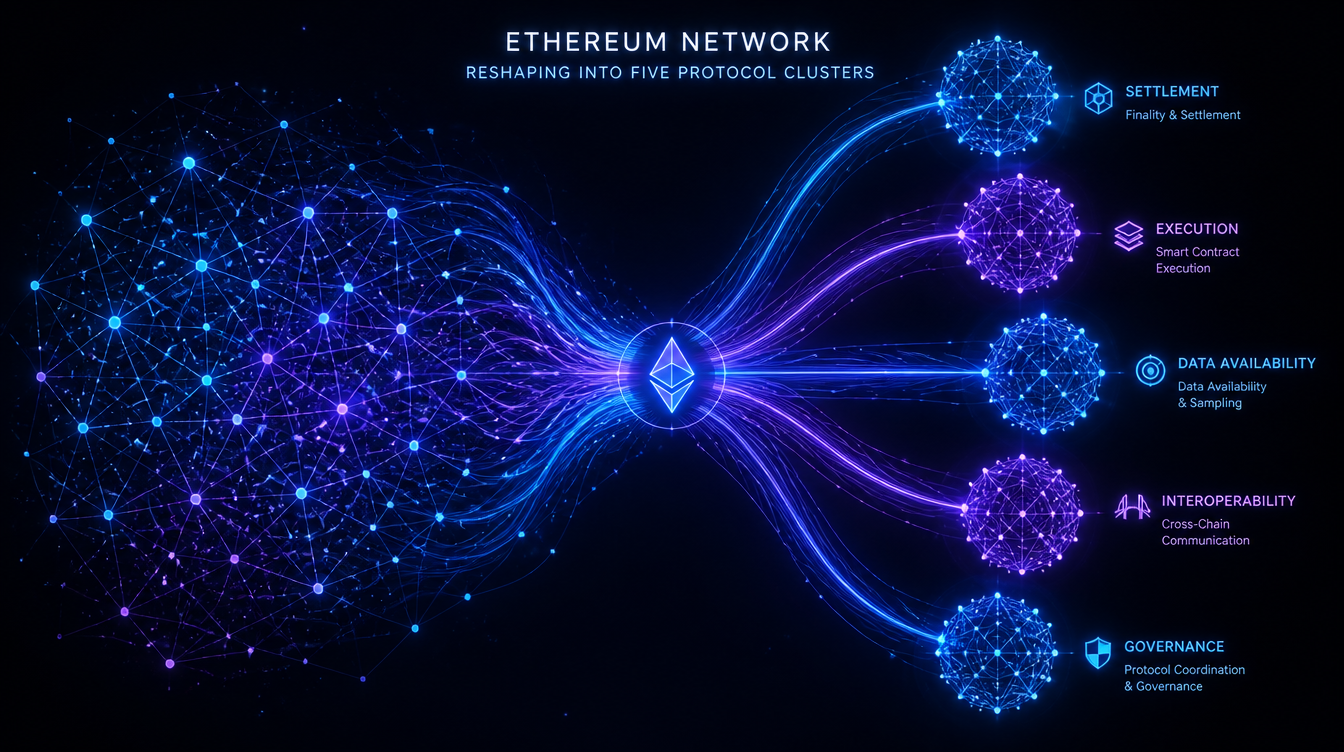
The Ethereum Foundation has cut 54 positions, reduced its 2026 budget by 40%, and reorganized its structure into five core clusters as part of a broader shift toward a leaner operating model and a long-term goal of limiting treasury spending to around 5% by 2030.
In a June 23, 2026 announcement, the Foundation confirmed it had reduced its workforce by roughly 20% from about 270 employees. Alongside the layoffs, it implemented a significant budget cut and restructured into five specialized clusters, supported by dedicated operations and management teams, according to a post published via Vitalik Buterin on the Ethereum Foundation’s official blog.
The move reflects more than cost optimization. It signals a strategic repositioning of the Foundation away from acting as Ethereum’s central development hub and toward a narrower role focused on protocol oversight, backed by a more conservative financial framework.
Five-cluster restructuring model
The new organizational design replaces the previous structure with five main clusters: Protocol Layer, focused on post-quantum security, zkEVM development, and Layer 1 privacy; Access Layer, building tools for users and AI agents to interact with Ethereum without intermediaries; User Layer, analyzing real-world network usage to inform protocol design; Community Layer, managing public engagement across crypto, open-source, and research ecosystems; and Institutional Layer, working with governments, enterprises, financial institutions, and academics.
The Protocol Layer’s mandate notably emphasizes that Ethereum should not be optimized for short-term market appeal or transformed into a traditional financial rail controlled by intermediaries. This underscores a deliberate separation between core protocol development and TradFi-oriented applications, even as the Institutional Layer expands engagement with external institutions.
Treasury strategy and financial discipline
The restructuring is tied to a broader treasury overhaul that began in 2025 and was formalized in a 2026 policy document.
At present, the Foundation spends roughly 15% of its treasury annually. Under the updated endowment-style approach, it aims to gradually reduce this to about 5% by 2030, which it considers a sustainable long-term spending rate, according to analysis referenced by CoinMarketCap Academy.
Departing employees will receive severance of at least one month’s salary per year of service, along with retirement payouts and additional support such as career coaching and ecosystem placement assistance. Since early 2026, several senior figures have exited the organization, including former co-executive directors Tomasz Stańczak and Hsiao-Wei Wang, with interim leadership currently in place.
The announcement also comes amid the emergence of Ethlabs, an independent protocol research group founded by former Ethereum Foundation contributors, highlighting a growing shift of development talent toward external ecosystem organizations.
Funding outlook and ecosystem transition
Following the announcement, concerns were raised that Ethereum’s core development ecosystem could face a funding gap within the next three to nine months, as existing incentive programs expire while Foundation spending is reduced.
This near-term period is seen as a critical transition window, separate from the longer-term question of whether the reduced-spending model can sustain research output at scale.
In the short term, focus is expected to shift away from ETH price action—which dipped modestly to around $1,668 on the news—and toward whether independent groups like Ethlabs and other ecosystem-funded teams can absorb research responsibilities previously supported by the Foundation.
At the same time, ecosystem players such as Consensys continue advancing related work in areas like zero-knowledge proofs, potentially overlapping with domains the Foundation is now de-emphasizing. The central issue is no longer whether restructuring was necessary, but whether decentralized funding channels can maintain continuity in Ethereum’s development roadmap.