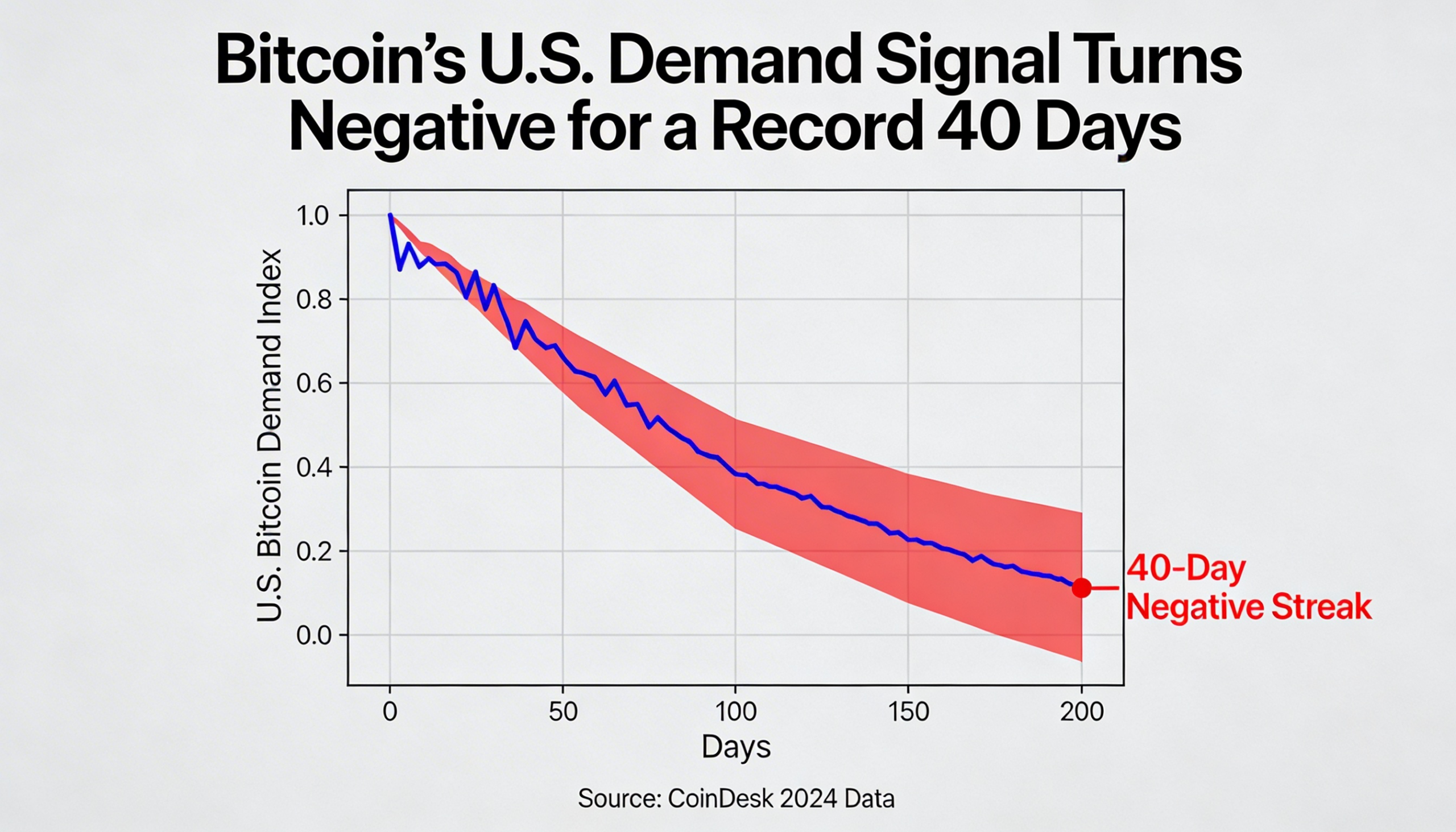
The indicator last moved into positive territory on Jan. 15, and its failure to reclaim that level following the Feb. 5 rebound suggests U.S. demand remains structurally subdued rather than temporarily sidelined.
In the days after the Feb. 5 sell-off, the closely watched Coinbase Bitcoin Premium Index appeared to show early signs of recovery. That improvement, however, did not hold.
According to Coinglass, the premium has now stayed negative for 40 consecutive days — the longest stretch below zero since 2023. The latest reading stands at -0.0467%, nearly unchanged from two weeks ago. At that time, a sharp narrowing from -0.22% had raised hopes that U.S. buyers were stepping in near local lows.
The index measures the price gap between bitcoin on Coinbase and the broader global market average. Because Coinbase is widely viewed as a proxy for U.S. institutional and dollar-based flows, a sustained negative premium signals that American investors are either distributing supply more aggressively than overseas participants or remaining largely absent from the market.
The prior record — roughly 30 straight days of negative readings — occurred during the October 2025 drawdown. That streak ended when a strong rebound drew U.S. capital back into bitcoin. This time, although bitcoin rebounded as much as 15% from its Feb. 5 intraday low and pushed back above $62,000, the premium failed to flip positive.
The divergence underscores a key shift: while price action improved, the composition of demand did not. The buying that propelled bitcoin higher appears to have originated outside U.S. trading hours, beyond Coinbase’s order books, or both.
There is one modestly encouraging development. Since early February, the discount has gradually narrowed from -0.22% toward -0.05%. While that reflects improving conditions, it has yet to cross into positive territory — a threshold that historically aligns with sustained accumulation phases rather than short-lived relief rallies.
Meanwhile, U.S.-based Google searches for “bitcoin zero” climbed to record highs earlier this month, even as global search interest remained relatively stable.
Taken together, the data suggests that American investor conviction is eroding at a pace not currently mirrored in other regions.