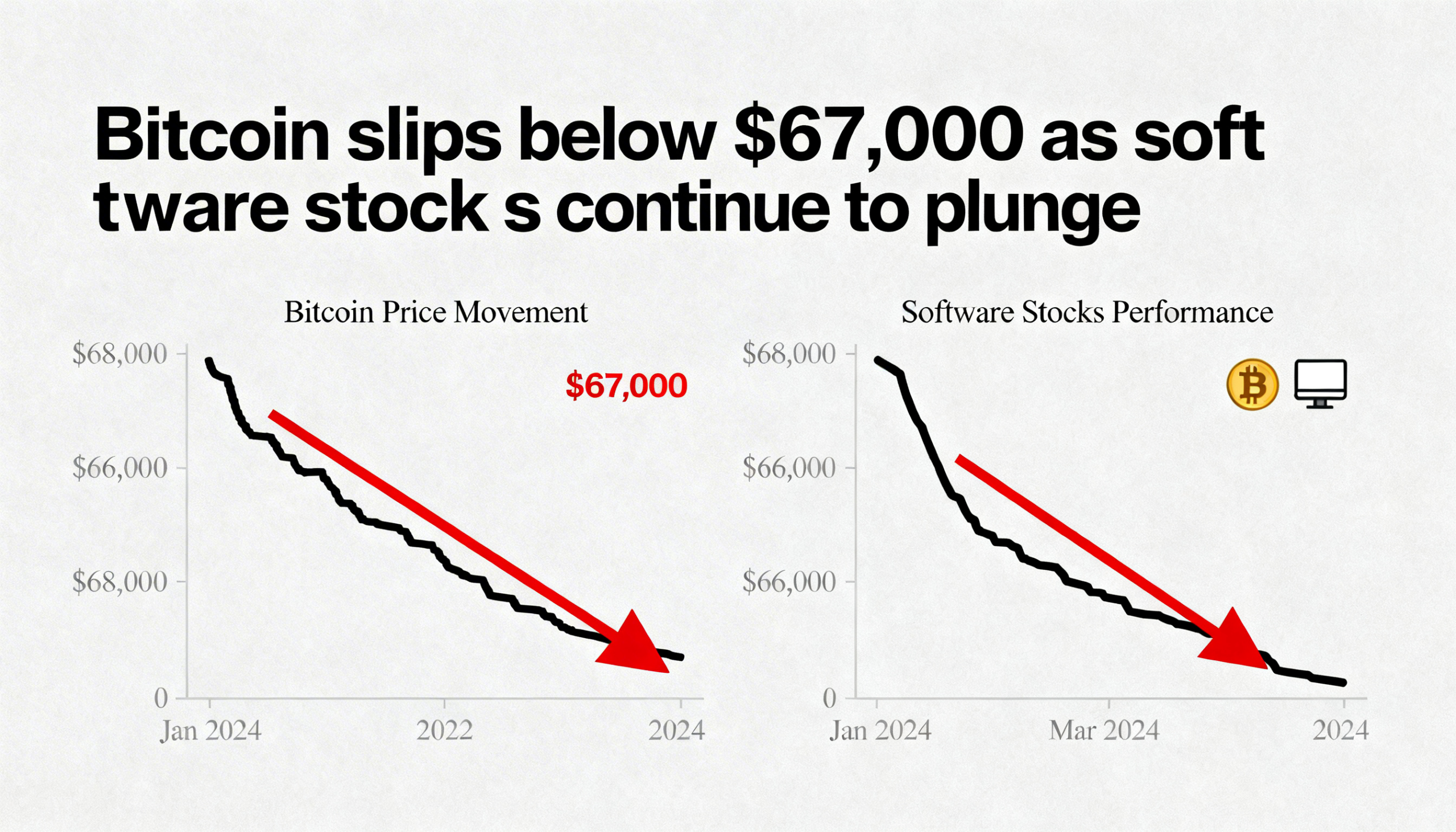
Bitcoin slipped beneath $67,000 on Tuesday as persistent selling in U.S. software stocks continued to pressure risk assets, reinforcing crypto’s close alignment with the tech sector.
After holding within a tight $68,000–$70,000 range over the weekend, bitcoin broke lower to trade near $67,173 at the time of writing. The move coincided with a weaker open in U.S. equities, led by renewed losses in software names.
The iShares Expanded Tech-Software Sector ETF fell another 3% on the session and now stands roughly 30% below its October peak. The sector has faced mounting headwinds as investors weigh how advances in artificial intelligence could disrupt established software business models.
Broader benchmarks also edged lower, with the Nasdaq Composite down 0.8% and the S&P 500 off 0.6%, underscoring a cautious tone across markets.
The pullback extended to precious metals. Gold dropped 3% to about $4,860 per ounce, continuing its retreat from record highs, while silver slid 6%, leaving it nearly 40% below its late-January peak.
Crypto-related equities followed suit, surrendering part of Friday’s rebound. Strategy (MSTR), the largest corporate bitcoin holder, declined roughly 5%. Circle (CRCL) also fell by a similar margin. Bitcoin miners and data center operators — including Riot Platforms (RIOT), MARA Holdings (MARA), CleanSpark (CLSK), Cipher Mining (CIFR) and TeraWulf (WULF) — retreated between 4% and 5%.
Market searching for direction
Paul Howard, senior director at Wincent, said digital assets remain closely tethered to macroeconomic sentiment.
“Macro developments have largely dictated crypto’s risk profile over the past 12 months,” Howard noted, adding that expectations for softer economic data are keeping investors in a defensive posture.
He pointed to a forthcoming tariff decision from the Supreme Court of the United States as a potential near-term catalyst that could carry more weight than routine economic releases.
For now, Howard anticipates further consolidation as bitcoin and the broader crypto market look for a narrative compelling enough to attract capital away from AI-driven equities and commodities.
“Crypto still needs to reassert itself as an appealing asset class,” he said, arguing that relatively low price levels alone have not been enough to draw investors back in.