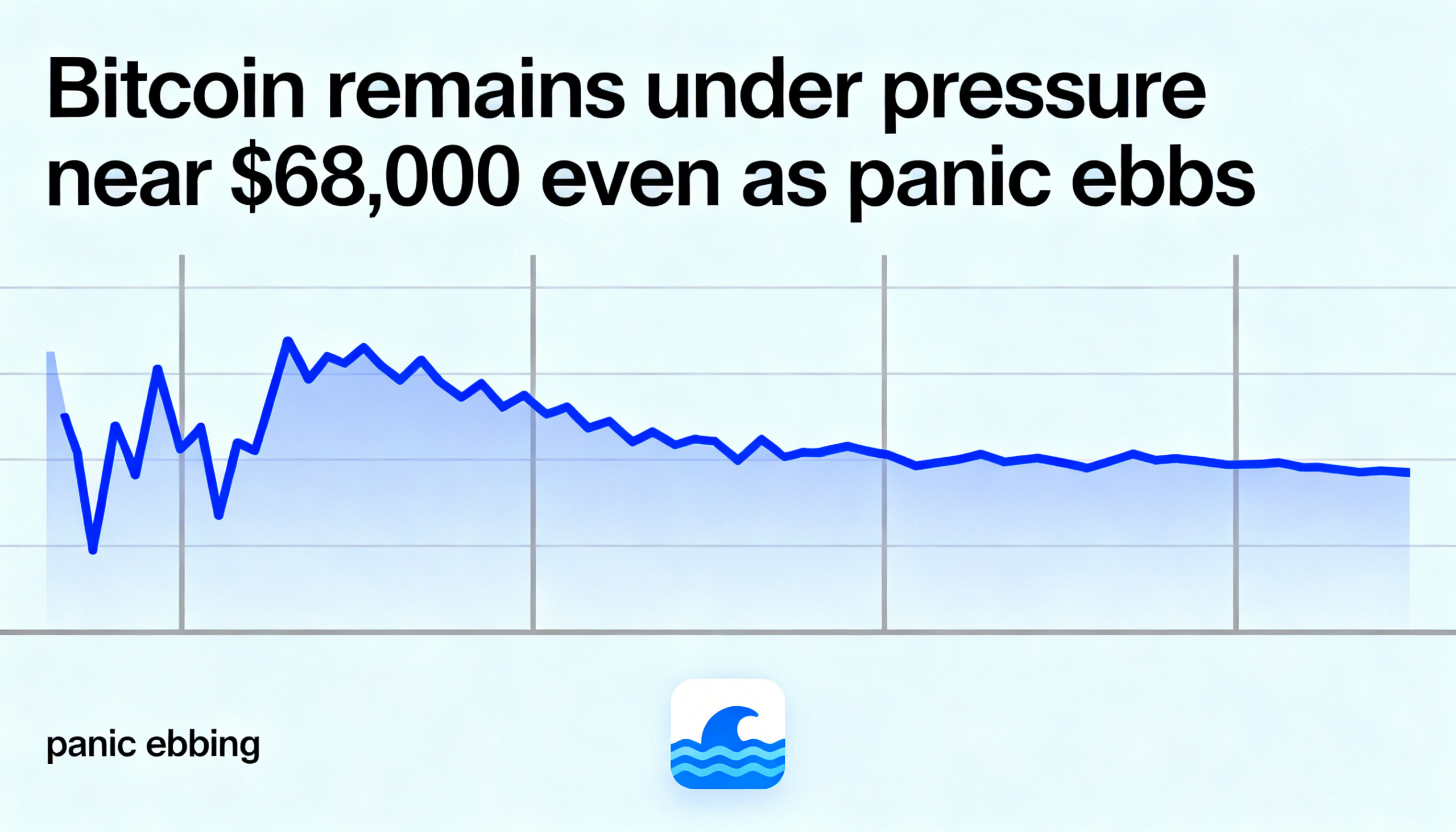
Bitcoin’s market has steadied following a sharp bout of volatility earlier this month, but derivatives data and fund flows suggest that demand remains restrained even as macroeconomic conditions begin to tilt more favorably.
The digital asset was trading around $68,000 at publication time, still struggling to build sustained upside traction. Although prices bounced from their early-February dip toward $60,000, repeated failures to reclaim $70,000 point to lingering hesitation among buyers.
A key measure of market stress has eased considerably. According to data from Volmex, bitcoin’s 30-day implied volatility has declined to an annualized 52%, down sharply from levels near 100% during the height of the sell-off. That earlier spike reflected a surge in demand for options protection as traders scrambled to hedge against further downside.
Options — derivative contracts used for speculation or insurance — tend to push implied volatility higher when demand intensifies. Call options allow traders to profit from upside moves, while put options shield against losses. The recent drop in implied volatility signals that panic-driven hedging and forced deleveraging have largely subsided.
Analysts at Bitfinex said the retreat in volatility suggests markets are stabilizing, though they cautioned that this does not necessarily signal a renewed wave of bullish positioning.
That caution is evident in perpetual futures markets. Funding rates — the regular payments between long and short traders that keep perpetual contracts aligned with spot prices — remain only marginally positive. While positive funding indicates a slight bullish bias, current levels show limited appetite for aggressive re-leveraging.
Institutional participation also appears muted. Data from SoSoValue show that U.S.-listed spot bitcoin exchange-traded funds have recorded roughly $678 million in net outflows this month, extending a three-month streak of redemptions and underscoring weak institutional demand.
Still, macroeconomic developments may offer a supportive backdrop.
Recent figures showed U.S. inflation easing, with the consumer price index rising 2.4% year-on-year in January, down from 2.7% in December. The softer reading has bolstered expectations that the Federal Reserve could deliver at least two 25-basis-point interest rate cuts this year.
Meanwhile, the real yield on the U.S. 10-year Treasury note has slipped to around 1.8%, its lowest since early December. Lower real yields generally improve the appeal of non-yielding assets like bitcoin by reducing their relative opportunity cost.
Analysts at Bitfinex noted that declining real yields narrow bitcoin’s carry disadvantage, while a softer U.S. dollar can ease global liquidity conditions — factors that could ultimately help risk assets regain strength.
For now, however, derivatives positioning and ETF flows suggest that while panic has faded, strong buying conviction has yet to re-emerge.