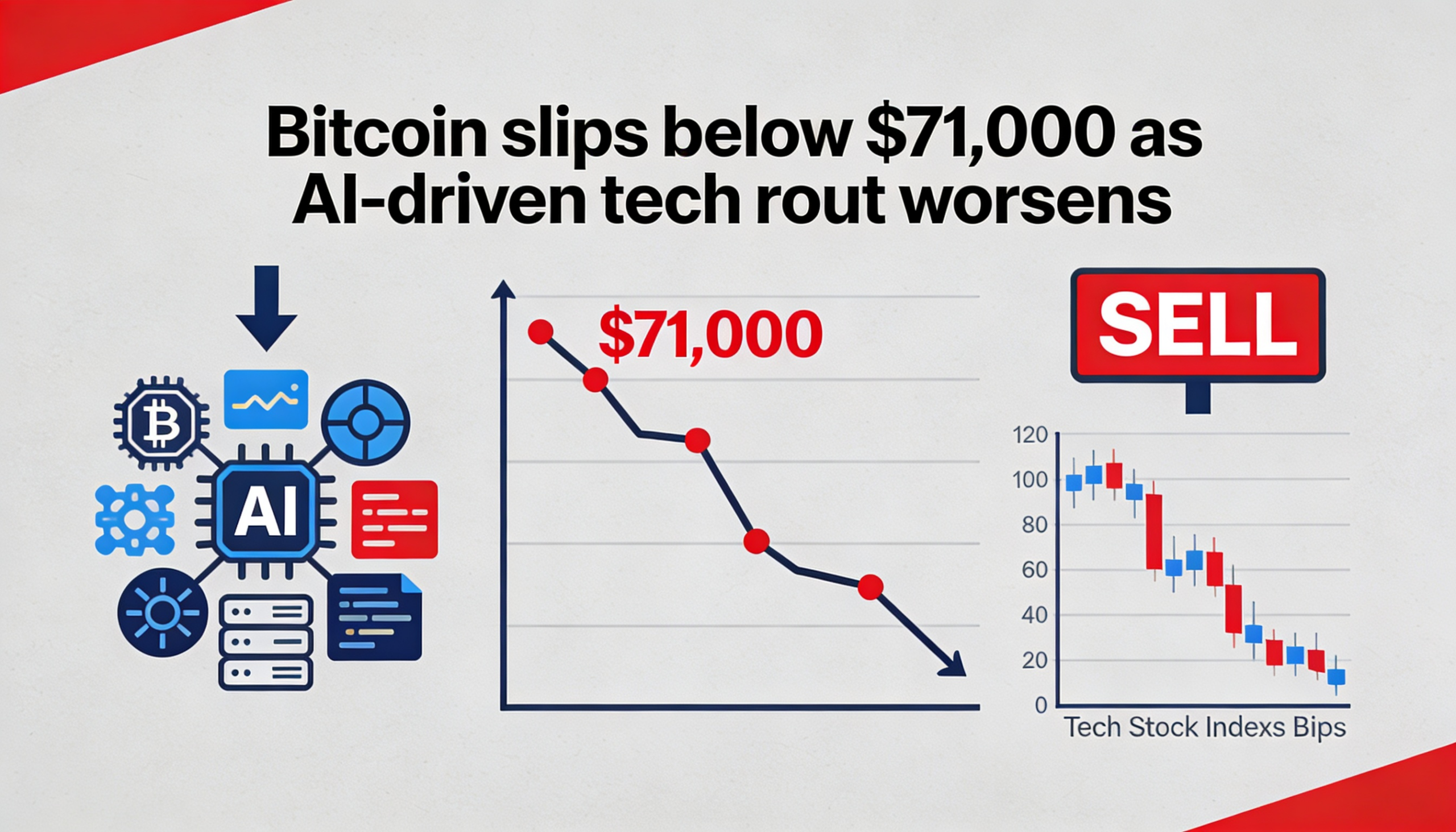
Bitcoin dropped below $71,000 during Asian hours on Thursday as a fresh wave of selling in global technology stocks spilled into crypto markets, erasing hopes of a sustained recovery after last week’s turbulence.
The largest cryptocurrency slid as much as 7.5% over the past 24 hours, briefly touching lows near $70,700 before trimming losses, CoinDesk data showed.
The decline tracked steep losses across Asian equities, where investors continued to retreat from risk amid concerns that artificial intelligence investment is peaking, valuations remain stretched, and earnings momentum is slowing.
MSCI’s Asia technology index fell for a fifth time in six sessions, led by a roughly 4% drop in South Korea’s Kospi as AI-exposed heavyweight stocks came under renewed pressure.
The selloff followed weakness in U.S. markets, where the Nasdaq retreated after disappointing earnings from companies including Alphabet, Qualcomm and Arm reinforced doubts about the sustainability of the AI-driven growth cycle.
Bitcoin has increasingly traded as a high-beta risk asset during equity-led drawdowns, particularly in environments marked by thin liquidity and heightened macro uncertainty.
The latest slide follows volatile trading earlier in the week, when bitcoin dipped toward $73,000 before rebounding above $76,000, a move some traders said reflected fragile positioning rather than a decisive shift in trend.
“Bitcoin’s break below the low-$70,000s has accelerated a broader deleveraging, flushing out crowded positions built during the post-ETF rally,” said Wenny Cai, chief operating officer at Synfutures. “Liquidations have been heavy, sentiment has turned decisively risk-off, and price action is now being driven more by balance-sheet mechanics than by narrative.”
“This does not mark the end of institutional participation, but it does signal an end to complacency,” Cai added.
Selling pressure was compounded by sharp moves in commodities, with silver plunging as much as 17% and gold sliding more than 3%, extending a violent unwind that has already triggered significant liquidations in tokenized metals products on crypto platforms.