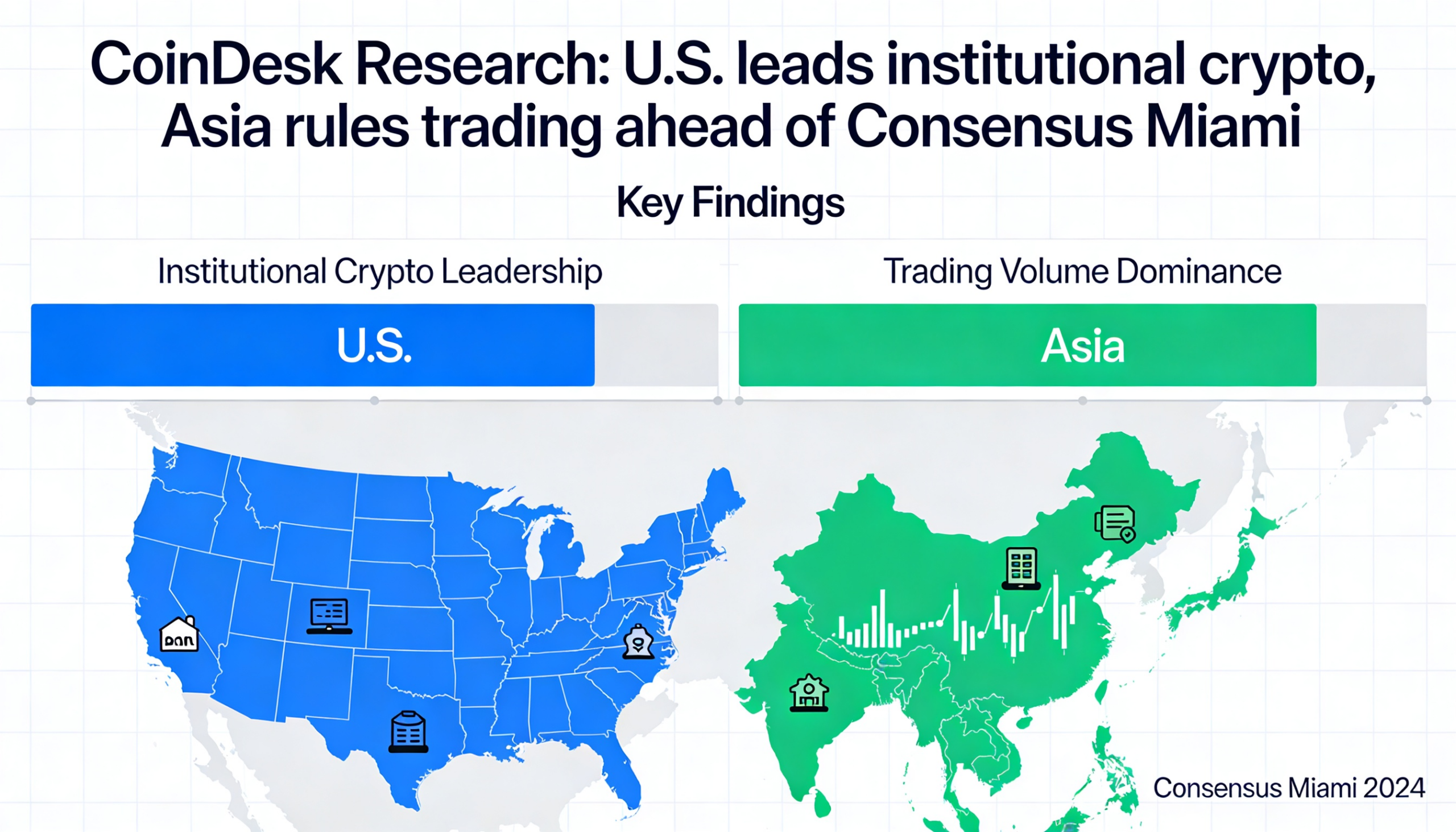
The global crypto market is no longer moving in lockstep. Instead, it is evolving into a layered system, with Asia emerging as the center of everyday activity, the United States consolidating its role as the institutional and regulatory anchor, and Latin America demonstrating how utility-based adoption can scale in real-world economies.
A new Global Digital Asset Adoption Index from CoinDesk Research, released ahead of Consensus Miami, highlights Asia’s dominance across key usage metrics. The region ranks first in exchange trading volumes, stablecoin transaction flows, and crypto ownership rates, reinforcing the idea that much of the industry’s core activity now occurs outside North America.
While Asia leads on usage, the U.S. continues to control the market’s institutional infrastructure. According to the report, America remains the top jurisdiction for exchange-traded crypto products, custody services, and regulatory clarity, positioning it as the preferred venue for compliant capital formation and large-scale institutional participation.
CoinDesk Research argues that this divergence reflects a structural evolution rather than a loss of influence for any one region. Liquidity, compliance, and user activity are increasingly decoupled, no longer concentrated in a single geography. Asia’s advantage stems from deep retail engagement and integrated financial platforms, while North America’s strength lies in sophisticated product offerings, established licensing frameworks, and close ties to traditional capital markets.
Stablecoins sit at the center of this split. In developed economies, they remain closely tied to trading and collateral use. In emerging markets, however, stablecoins are increasingly used for remittances, cross-border payments, and inflation hedging. The index shows that this utility-driven demand continues to support transaction growth even during periods of muted price action.
Latin America offers a clear example of this third path. In several countries, dollar-pegged stablecoins function less as speculative instruments and more as financial infrastructure, enabling commerce, facilitating remittances, and preserving purchasing power amid currency volatility. This has helped maintain steady transaction volumes even during broader market downturns.
The result is a multipolar digital asset ecosystem, where leadership is defined less by geography and more by which layer of the crypto stack is under examination—from retail usage and payments to regulation, custody, and institutional capital.