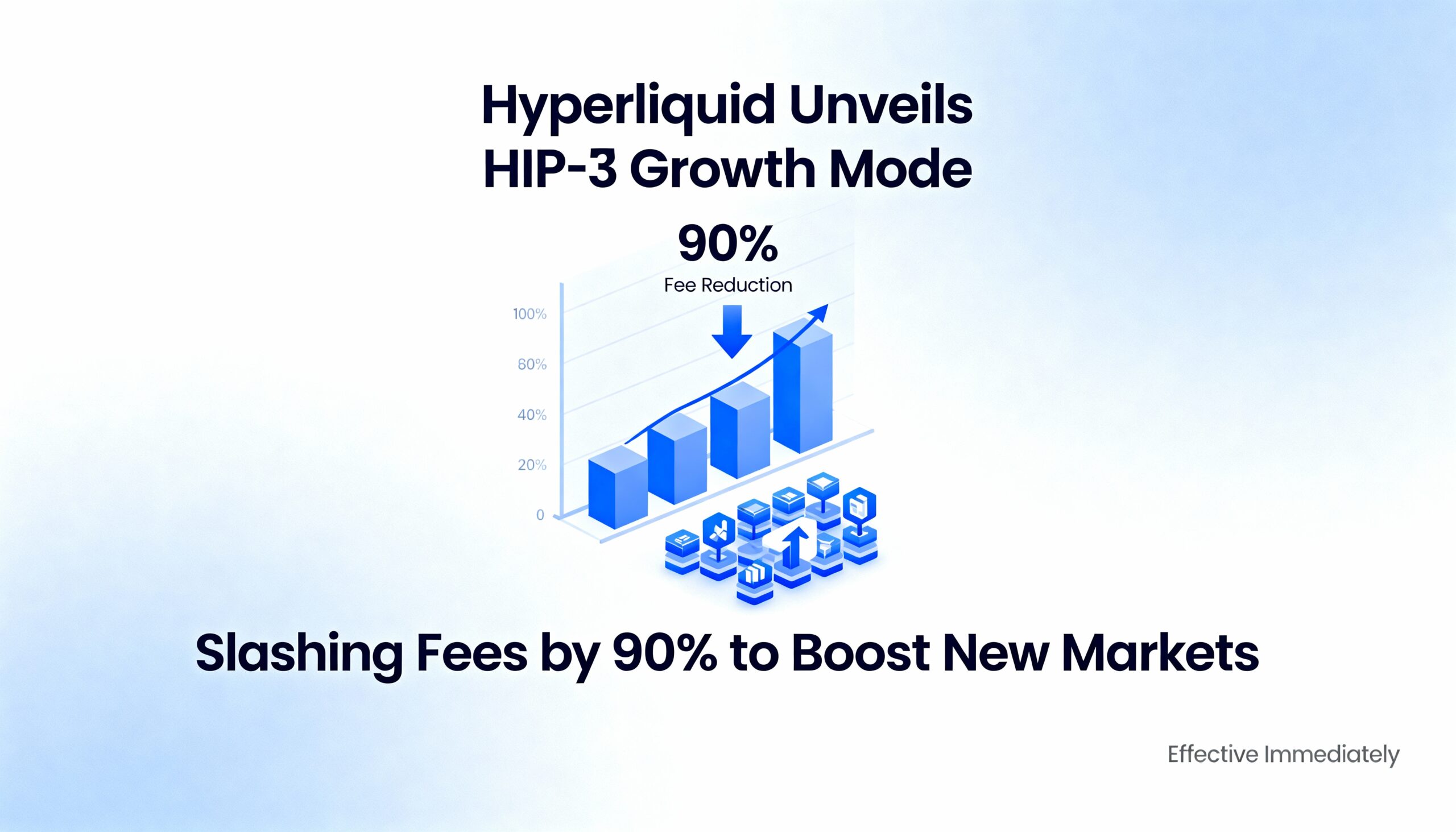
Hyperliquid has rolled out HIP-3 “growth mode,” a major upgrade that enables anyone to launch new markets permissionlessly while benefiting from sharply reduced trading fees—a move designed to accelerate liquidity expansion across the platform.
With HIP-3, deployers can activate growth mode for individual assets without any approval, unlocking taker fees that are more than 90% lower than the exchange’s standard rate. The initiative is intended to lower barriers for new listings and attract a wider set of market makers.
Under the new model, taker fees drop from the typical 0.045% to as low as 0.0045%–0.009%, with the possibility of reaching ultra-low levels of 0.00144%–0.00288% for users at the highest staking or volume tiers. Hyperliquid says the fee reductions are central to its strategy of widening asset coverage and competing more directly with centralized venues.
Taker fees apply when traders remove liquidity by immediately matching existing orders on the order book.
To launch a market in growth mode, deployers must select a fee scale between 0 and 1—representing the portion of trading fees they retain before collateral-based discounts. Markets created under HIP-3 must also be distinct from validator-run perpetuals to avoid cannibalizing existing liquidity. That excludes crypto perps, index-style products, ETF analogs, or any asset closely tied to an existing market such as gold perps linked to PAXG-USDC.
Once enabled, growth mode remains locked for 30 days to maintain stability and prevent rapid toggling.
The announcement quickly gained traction on crypto social platforms, where users hailed the upgrade as a major catalyst for Hyperliquid’s ecosystem.
“One of the biggest accelerators we’ve seen—fees are dramatically lower than on legacy chains,” one X user wrote. “This unlocks totally new categories: real-world yield instruments, niche commodities, tokenized treasury products. Deployers will rush in, and traders should expect volume spikes and narrower spreads.”
Hyperliquid’s native token HYPE, however, slipped 6% after the news and is currently trading below $40.