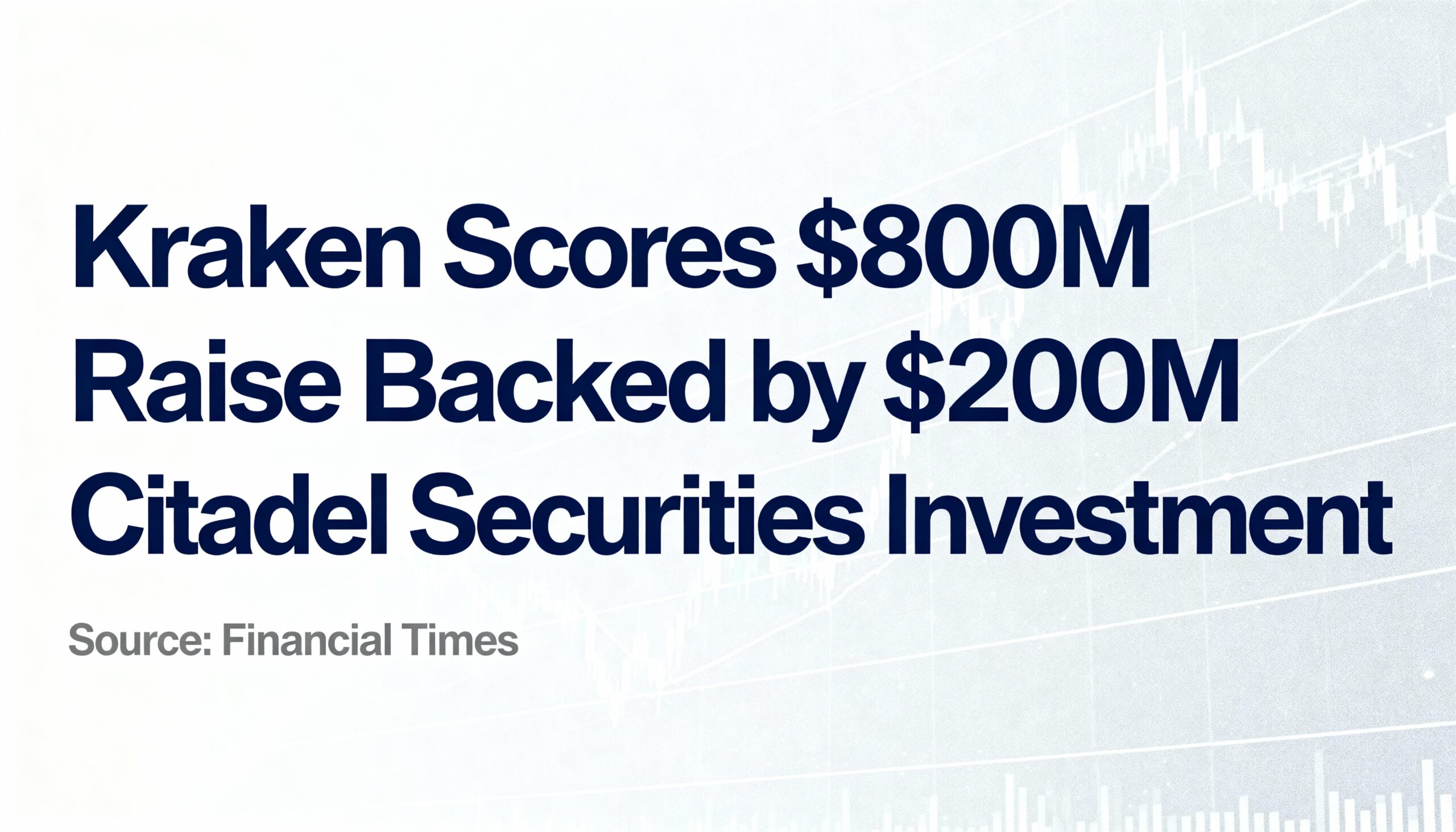
Kraken has secured $800 million in new financing — including a $200 million investment from Citadel Securities — pushing the crypto exchange’s valuation to $20 billion and advancing its ambition to merge traditional financial markets with blockchain-based infrastructure.
The raise was completed in two parts. The primary tranche attracted major institutional backers such as Jane Street, DRW Venture Capital, HSG, Oppenheimer Alternative Investment Management and Tribe Capital. Citadel Securities then followed with a $200 million infusion, cementing a strategic partnership between the firms.
Founded in 2011, Kraken operates a regulated, vertically integrated platform spanning spot and derivatives trading, tokenized assets, staking, payments, custody, clearing, matching and settlement. This full-stack model allows Kraken to roll out new multi-asset products quickly while maintaining compliance and operational control.
“Our mission has always been simple: build a platform where any asset can be traded, anytime and anywhere,” said Kraken co-CEO Arjun Sethi. He noted that participation from firms like Citadel Securities and Jane Street underscores confidence in Kraken’s infrastructure-first approach.
The funding round represents a major shift for the company, which had previously raised only $27 million in primary capital. Despite minimal external investment, Kraken generated $1.5 billion in revenue in 2024 and exceeded that total again by the third quarter of 2025.
In the past year, Kraken has expanded aggressively into traditional and tokenized markets — acquiring NinjaTrader to support U.S. futures trading, introducing tokenized equities, and launching its global KRAK app for payments, savings and investments.
Citadel Securities President Jim Esposito called Kraken a “key leader in the next phase of digital market evolution,” adding that the firms will collaborate on liquidity provisioning and risk management — areas where Citadel Securities has long shaped traditional market structure.
With its new capital, Kraken plans to scale operations across Latin America, Asia Pacific and EMEA, while adding new trading tools, institutional services, staking products and payment solutions to meet rising global demand for regulated access to digital and tokenized assets.